
‘This film was made in secret. When there is no way, a way must be made.’ These are the first words seen as The Seed of The Sacred Fig begins and it immediately exercises the urgency and importance it has. After making this film and its selection at Cannes film festival 2024, director Mohammed Rasoulof was interrogated by Iranian authorities and made to pull the film from the Cannes line-up. He was banned from leaving Iran and in May 2024, he was sentenced to 8 years in prison. With many of the cast and crew, Rasoulof fled Iran on a 28 day voyage and eventually managed to settle in Germany.
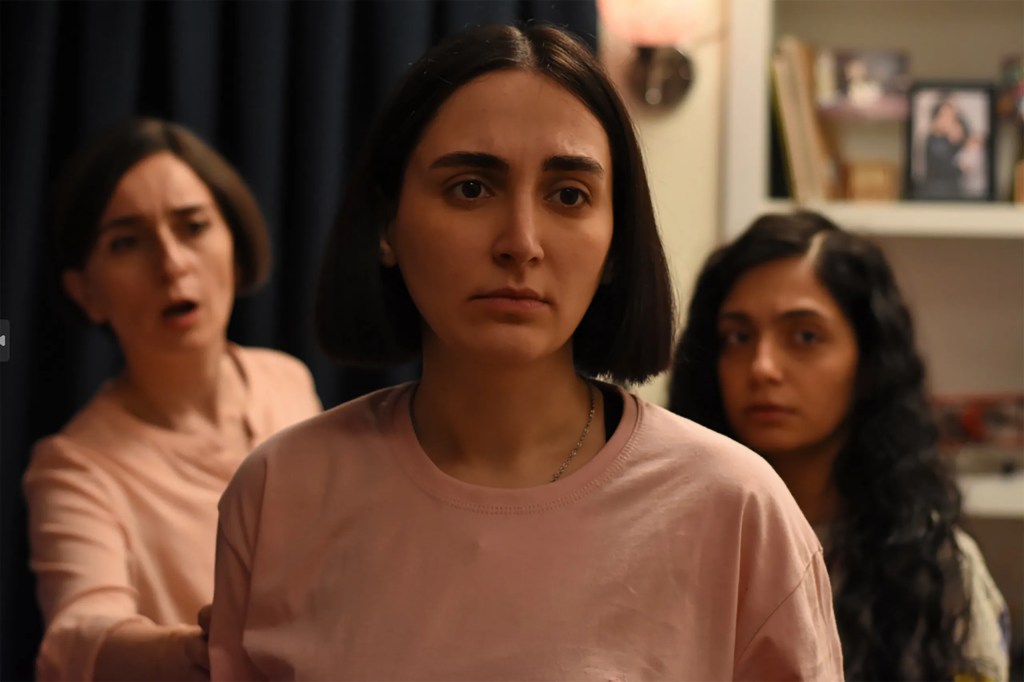
Set in Tehran during the 2022-23 protests against the compulsory wearing of the hijab in Iran’s theocratic dictatorship, The Seed of The Sacred Fig follows a father, Iman (Missagh Zareh), a mother, Najmeh(Soheila Golestani) and their two daughters, Rezvan (Mahsa Rostami) and Sana (Setareh Maleki). Iman has just got a job as an investigative judge and yet is just asked to approve those indicted for whatever their sentences may be, including death sentences. His predecessor was fired for refusing to do so and thus is forced to comply in order to achieve his now much higher salary. With the constant protests going on around them, Rezvan and Sana witness what is happening and support them. This rebellious stance creates a rift in the family and we watch as a once happy family slowly crumble.
Even outside of the production and contexts of this film, it helps that this is simply excellent filmmmaking. Rasoulof has done an impeccable job of bringing all this together under pressure and it really is something to behold. The writing, first of all, is just top notch. Every single character is so well defined and you know exactly where they all stand within the family and amongst the societal events surrounding them. None of it is done in a heavy-handed manner and there is so much nuance to their actions. Najmeh is a particular highlight because she is obviously conditioned to be against the protests and support her husband through everything. However, seeing how her daughters react to events and how cold Iman can be, she begins to question her whole life and the role she has been playing for the 20 years she has been married. Why shouldn’t she want more rights for herself? And why should she be the one to tell her daughters they shouldn’t? It just works on so many levels and she is just one example. Another is Iman, who is consumed by everything going on with developments in his job and his family working against him. He can’t sleep, he is constantly working and you can feel his headache from all of his stress.
All the performances carry these characters even further. Golestani as Najmeh is once again my standout but there are no weak links at all. The performances exceptionally convey their personalities in such a way that we can see what they feel and what they will do. Golestani’s facial expressions show her fear to rebel and how trapped she is, doing things she knows aren’t right but needs to uphold her loyalty to Iman. Rostami as Rezvan is another standout, acting as an embodiment of the protesting movement. She perfectly demostrates anger towards her mother that she won’t stand up to her husband but also the compassionate tenderness of her understanding she has been brainwashed into being complicit. Iman’s stress overload is wonderfully written but also excellently performed by Zareh and as he tips over the edge progressively, Zareh only gets better.
Possibly the most excellent aspect of this film is the edit. It is wonderfully paced with an equally great and distinct structure. This is quite a long film at 167 minutes but it does not even slightly feel like it. It helps that with a relatively wordy first couple of acts, the third act is one of the most nail-bitingly tense sequences in a long time and it is exhilarating. Finally, the decision to put real life footage of the protests, and the excessive force that came with it, at little intervals throughout the film is genius. It acts as a constant reminder of the horrible climate of the country and it is most effective when done towards the end.
This film is a hard watch for many reasons but it is likely the most important film you will watch this year (‘this year’ being 2024 because of Britain’s as ever late distribution). It is a call for change and a rallying cry for all the lives that were lost in those protests. Cinema, and art as a whole, is best when it has something to say and demonstrably, this says a lot. The Seed of The Sacred Fig is an effective case for the power of cinema and it is an essential masterpiece.

 Screen Addict
Leave a comment