
When films nowadays love to bash round your head the fact they were ‘based on a true story’, you know what you are in for right from the jump. It is hard to say whether it is just a drought in the flow of ideas or just not being able to explore their material properly but they have recently been falling rather flat. Examples like One Life with Anthony Hopkins last year or the very recent Last Breath are ok but nothing particularly special. They often just allow for the source material to guide it and that makes them suffer as films because it is not like the actual source material is a merit of the film itself. Many of these films seem to think like this and the way the audience is delivered the story is half-baked as a result. Now this is certainly the case with The Penguin Lessons but fear not because there is a cute penguin for you to look at too.
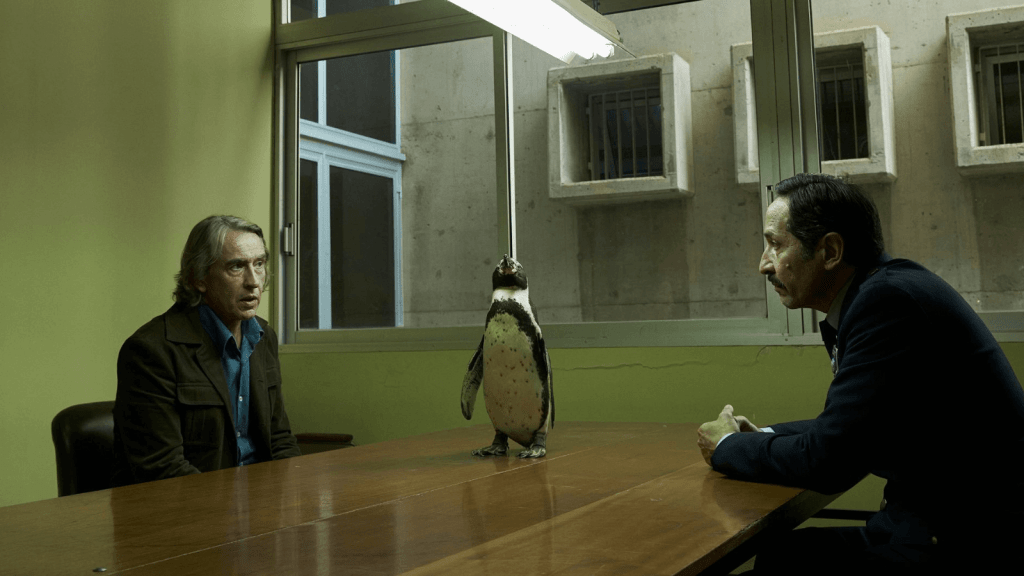
The Penguin Lessons follows Steve Coogan as Tom Michell, of whom’s memoirs this film is based on. Set in Argentina 1976, Tom has arrived at an all boys school called St. George’s to be their new English teacher. Due to political turmoil surrounding the coup d’état currently taking place, a nearby bombing forces the school to close before Tom can really get started with his teaching. He uses the week off to go to Uruguay with fellow teacher Tapio. Whilst there, he tries to let loose and woo a woman he has met named Carina. This leads to him encountering a lone penguin on the beach, that has been caught in an oil slick. He helps clean it up and tries to bring it back to the sea, only to realise that this penguin will not go away as easily as he had thought.
Uncontroversially to say, the penguin is very cute. But you will never find it as cute as director Peter Cattaneo does. This is the main issue with the film and why it becomes increasingly frustrating. Narratively, this film can be split up into two main throughlines: the effect of the coup d’état and then everything going on at St. George’s. Particularly in the case of the former, parts are written well. Sofia, for example, is a cleaner at the school and she is a political activist. She fights as a voice of the youth and her needing to do anything she can to fight against the regime is admirable. Her story is certainly one of the more engaging segments but it needs just a bit more going for it to be truly impactful. Its subject matter is begging to be explored here and it does not quite do it justice. As the film tells you during its ending titles, over 30,000 people during this period disappeared and have never been found since because of how oppressive the regime was. Why just show this during the ending titles? Show us more instead and let us feel that impact. Seeing as Sofia’s story is the only attempt at dealing with this subject matter, it really needed more and it makes side of the story is a bit undercooked. Even more frustrating is that in this same film, you have multiple scenes of a penguin waddling about that kill any real engagement.
Tonal whiplash is the thing that makes this film messy so often. The two narrative focuses just do not work together. You simply cannot have what is a really gruelling scene of activists being silenced and taken away to be followed by a scene of a penguin in a classroom. When put like that, it sounds profoundly stupid but this same sort of thing happens much more often than it should. This film is not short either, clocking in at 110 minutes and you could shave off ten minutes of the penguin stuff to properly develop the coup d’état side of things and the film would be much better for it. The edit does not just need to be tighter in that regard, it also needs to guide much more slower to the penguin stuff. Juan Salavador waddling about should be the breathing points between much of the films more tension-filled moments but it ends up taking too many breaths. To an extent, the narrative of St. George’s does have nice sentiment at least and it is at least thematically consistent with the coup d’état scenes. It is very much to do with freedom of oppression but also teaching the children to still be children even in the tougher times. When the film sticks with either narrative, it can work at points. The problem is it seems to have a lack of focus that is highly accentuated with this constant tonal issue.
The Penguin Lessons is not a bad film and although this film has mostly been negative, it is still fine to watch. It just yet again suffers from that overconfident ‘based on a true story’ packaging that for some reason, films seem to think that automatically makes it interesting to watch. The subject matter it works with is interesting and if it committed to either of its narrative strands more, it would be much better for it. Steve Coogan lifts this film up considerably with his charm and yes, of course the penguin is cute. It doesn’t make you forget it but the penguin is fun to watch and many of the film’s laughs come from it. Just perhaps a little bit less time purely fixed on the penguin and more development in other areas and you are on your way to a much better film.



 Screen Addict
Leave a comment