
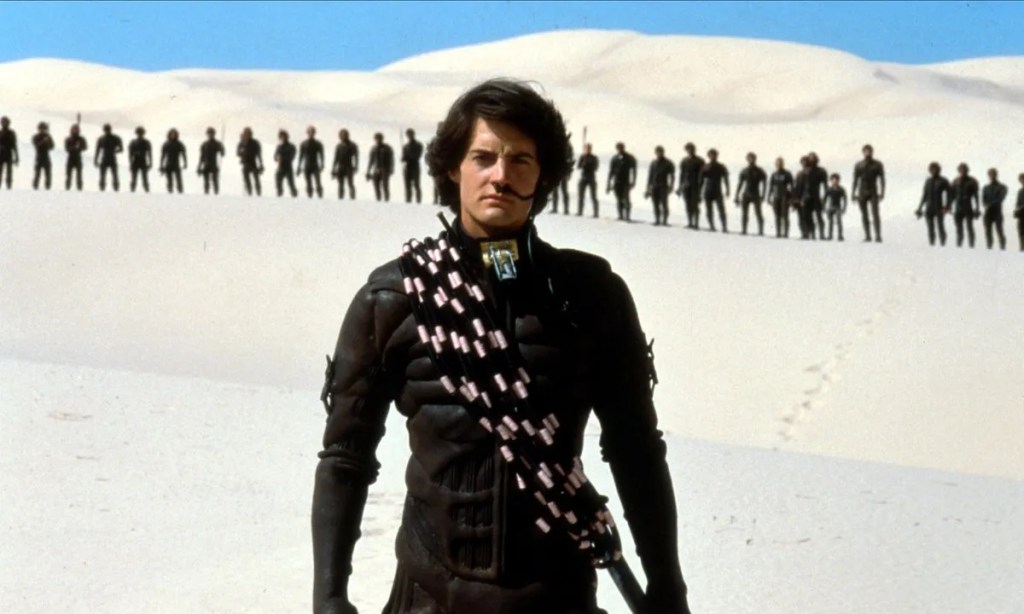
After Lynch’s successes with Eraserhead and The Elephant Man, he was starting to become a much more noticeable name in the industry. Unfortunately with how Lynch’s experience directing Dune ended up, it’s fair to say he may have wished he did not garner so much attention. With the film rights initially picked up in 1971 for Frank Herbert’s 1965 novel, an adaptation for Dune seemed to be impossibly hard to make and it all seemed doomed from the start. With the infamous stories of Alejandro Jodorowsky’s failed attempt, to even a potential Ridley Scott version in 1979, production on this film changed more than a few hands. Producer Dino De Laurentiis had to renegotiate the rights in 1981 because it had been left so long. His daughter Raffaella, who was also a film producer, suggested Lynch after seeing The Elephant Man. Lynch had not heard of the book but read it and loved it. Little did he know that the slog of making the film would be one of the biggest mistakes of his career. Before Lynch died, he would not even talk about this film. Through lots of studio interference during the original and abandonement of sequels due to underperformance, Dune was always a point of heartache for Lynch. He vowed never to even watch the excellent modern Denis Villeneuve adaptations either, not out of hatred but purely because it would bring back too many bad memories.
Dune follows the story of the original Frank Herbert novel of the same name. Kyle MacLachlan stars as Paul Atreides who has to adapt to new life on the desert planet of Arrakis due to his house moving there. House Atreides is tasked with running spice production, spice being the source of power in the universe due to its powerful capabilities, including interstellar travel. After a political threat is uncovered and the rival House Harkonnen starts to get more malicious, Paul must delve into the desert for the help of the Fremen. These people believe him to be a man of their prophecy, a powerful being called the Kwisatz Haderach. Paul must embrace his destiny and fight against House Harkonnen to save those he loves.
It may be an understatement to say that this is a wildly different film from anything Lynch had been attached to in the past. There is little very Lynchian about this either so it just feels like a strange void in Lynch’s career. I will say that the only way I have been even slightly able to give a sort of synopsis for this film is that I have watched and loved Villeneuve’s films. I cannot possibly imagine going into watching this knowing nothing about the story and frankly, I am glad I have been spared that trouble. Eraserhead‘s story is relatively incomprehensible on the surface but things start to make sense whenn you follow the breadcrumbs that Lynch has left. This on the other hand is strange and incoherent to the point of insanity and there is very little below the surface. It has some semblance of a plot but it is extremely difficult to follow. Paul is the most likeable character but that is not really saying much at all because most people in this film are lifeless. Baron Harkonnen (Kenneth McMillan) is probably the most entertaining to watch because the performance is so over the top that it is laugh out loud hilarious. Because of this film’s insanity, you would think there would at least be a lot going on but there really isn’t. In fact, the film is rather boring most of the time and it does not help that it is 137 minutes long. It is a hard watch and if you have no context to help you spot certain scenes, you are going to be incredibly lost watching this.
Even with its fever dream like plot, perhaps the biggest confusion of this is where the budget went. The budget was in the region of $40-42 million which obviously at the time was quite huge. However there is nothing to show for it with some of the worst and most laughable effects you will ever see and its generally quite ugly and boring production design. The combat shields being these big blocky pieces of computer-generated nonsense never fail to amaze. Now obviously, this was 1984 so the effects are not going to look amazing by today’s standards. When you put into perspective though that the 1980s saw incredible effects work from the likes of Carpenter’s The Thing and Cronenberg’s The Fly two years either side of this film, that highlights how terrible it really looks.
There really is not much good about this film and Lynch probably would have agreed. Messy and incoherent, Dune is quite easily the worst Lynch film I have seen thus far. The book was always seen as incredibly hard to adapt and this film cemented this feeling. Nobody cared for the film critically and it underperformed greatly at the box office, removing any chance (or worry) of a sequel. These factors just make Villeneuve’s version even more of a miracle and if you are interested in seeing a version of Dune, watch that one rather than Lynch’s. It is seen as his bastard child for a reason and its no wonder he basically disowned this as soonas he got the chance.

 Screen Addict
Leave a comment