
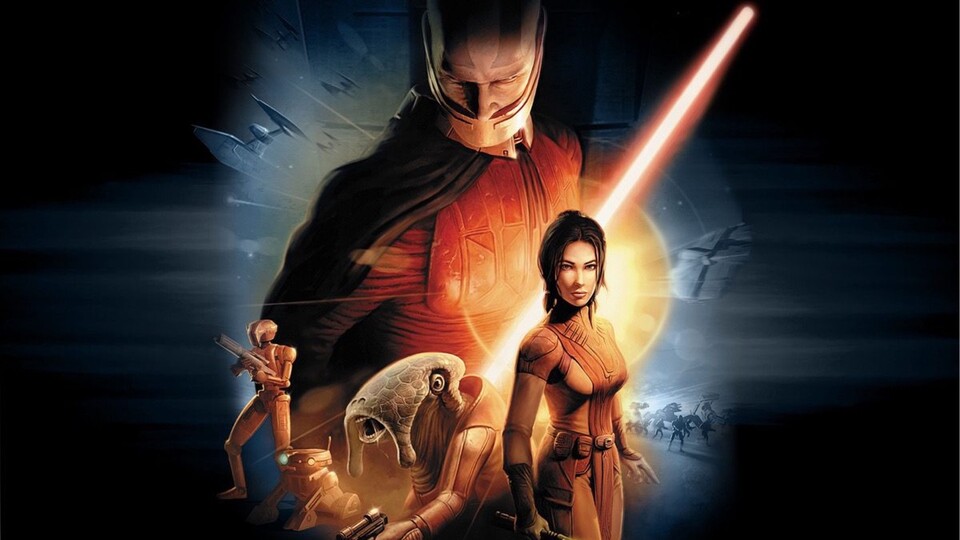
May the four(teen)th be with you! On May 4th, a religious day for us Star Wars fans, I decided to celebrate by delving back into one of my favourite games that I haven’t played in a long time – Star Wars: Knights of the Old Republic (KOTOR). Coming up to almost 22 years old now, this was one of Bioware’s first heavy hitters. Having done Baldur’s Gate I & II and Neverwinter Nights, this was their first delve into the science-fiction RPG, still a few years before Mass Effect. What we see in this game is blueprints for everything that Bioware had to offer later on. It has their trademark loveable characters, immensely well done world-building and some simple, yet effective, RPG systems and combat. All of this with a Star Wars flavoured layer of icing over the top and you have got yourself a fantastic video game. Though some of its systems and charms have aged better than others, this is still a brilliant game to play, Star Wars fan or not.
Perhaps the most interesting thing about KOTOR in its relation to Star Wars is its place within the timeline. This is a long LONG time ago in a galaxy far away as it is set around 4000 years before the original films. Setting it this far away from the originals is something modern day Star Wars seems to be afraid of doing and everything nowadays is so tied down by the Skywalker Saga. Being 4000 years before, KOTOR has essentially free reign with its story, characters and world. It follows your own created character waking up on a Republic ship that is under attack by the Sith. Darth Malak had been aiming to kill the Jedi Bastila Shan who, like most people on the ship by the point you wake up, had evacuated in an escape pod to the planet Taris below. After escaping the ship with Republic soldier, Carth Onasi, you too are on Taris and trying to find Bastila before the Sith do. After havings strange visions that somehow connect you, Bastila and Malak’s former master Darth Revan, it becomes clear that Malak’s operation is bigger than her and bigger than just Taris. A galaxy spanning adventure ensues whilst trying to stop Malak’s plan and uncover the dark mysteries of Revan.
Most importantly before anything else, Bioware makes excellent usage of the Star Wars IP with a story that feels distinctly within that world. Even being 4000 years away from any previous experience you will have of the franchise, there is still a wonderful familiarity flowing through everything. Of course, there are things from the films like Tatooine with its Jawas and Sand People or Wookiees on Kashyyyk but the world is built to feel so much bigger than that. Even if its on the planets we know, hearing Anchorhead on Tatooine or the planet of Dantooine mentioned in the films, and then being able to visit those places is every Star Wars fans’ dream. The expansion on what we know is welcome but the introduction of things we don’t is even more so. Visiting the homeworld of the ancient Sith order on Korriban (now named Moraband in the official continuity) and getting to experience the Valley of the Dark Lords is a great example of how well this game does its world building. There is always a shroud of mystery concerning the Sith in the Star Wars universe and though we never see areas like this in their prime, having a little taster is just right for keeping the mystery but also making you massively intrigued in what they once were. Hearing about key events like the Mandalorian Wars is never shoved down your throat and passing mentions just make you want to read up on them and see what they were about. Star Wars has some of the most deep lore in franchise history and this game is a perfect example of why it should be explored beyond that 50 year period that the films obsess over.
KOTOR‘s story is its most universally praised aspect and for good reason. At this point in time looking back at Bioware’s back catalogue, this is a classic Bioware story. It is full of brilliant characters and companions with compelling backstories that you will want to ask them about and learn more. A good example is Juhani who when you first meet her, she is consumed by the dark side. You fight her and it is easy to miss having her as a companion altogether because it would be much easier to just kill her than trying to persuade her back to the light. However keeping her as a companion is interesting because she talks about her conflict and how easy it is to give into fear, really establishing the dark side as this easy way out. Whenever you are fighting dark side characters with her by your side, she will try herself to convince them back to the light because she has experienced those same temptations and knows their costs. All of this you can miss just from giving up on her at a crucial moment and that certainly shows how meaningful the dialogue exchanges can be. There is a light/dark side point system throughout that leans you either way dependent on your choices but the game is not so dogmatic in its representation of the light side being right. There is a lot of criticism of the Jedi code and how flawed it can be, even from some of those closest to it. It is much more subtley portrayed than in the prequels and it even has examinations of Grey Jedi who walk between sides with Jolee Bindo’s character. It is impossible to talk about this game without mentioning its huge narrative twist towards the end of its second act too. I will not spoil it but it’s a perfect example of how this game frames the force as not all black and white. As much as the dark side is evil, the light side has some big moral flaws and they are explored thoroughly.
People often criticise KOTOR‘s gameplay and it is true that by today’s standards, it can be rather clunky. Combat is a blend of real-time and turn-based, very similar to what Bioware would deliver in Dragon Age: Origins a few years later. It is certainly simplistic and not special by today’s standards but it is still very satisfying. It is as simple as clicking on an enemy and selecting which ability you want to do, whether its a flurry of swings from your melee weapon, a powershot from your blaster or even force powers. You can have two companions accompanying your character at anytime and with the ability to pause time, you can strategise quite competently. It is all to do with rolls and saving throws so hitting things is luck based. This can make the game infuriating but when everything does go well and you manage to completely decimate a boss by stunning it and wellying it with all your lightsabers, it is very satisfying. The RPG systems are basic but effective and involve attribute points, skill points and the allocation of feats and powers. There is a lot of gear to pick up too but towards the end, it feels like there is just too much gear in your inventory to want to bother changing anything anymore. Everything here is what you would expect from an RPG of this era and as much as these systems are familiar now, this game had a helping hand in making this the case.
Overall, if you are a Star Wars fan in any capacity and you have not played this, what are you doing? Even if you aren’t too familiar with the franchise, there is enough here that stands on its own outside of its Star Wars glossiness. As somebody that loves Star Wars and loves RPGs though, this game is a match made in heaven for me. I have played this multiple times but not for a few years so it has been a joy to come back to it and try to really deconstruct why it’s so great. I have only played its sequel once but I am certainly feeling the urge to give it a go because some say it’s even better! Whenever the remake of this eventually comes out, if ever, I really hope they do it justice because this is as good as Star Wars gets outside the original trilogy.


 Screen Addict
Leave a comment