
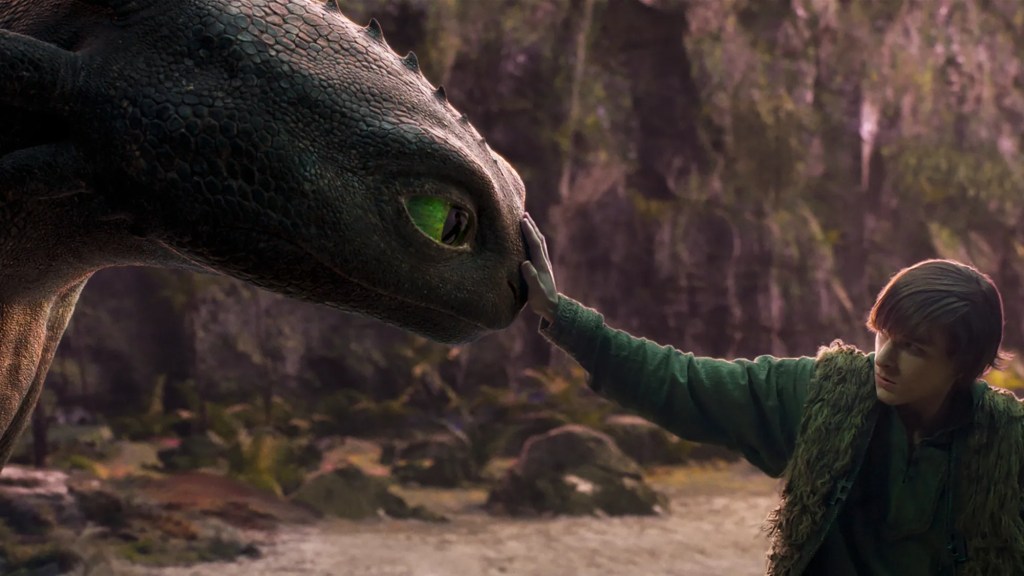
The original How to Train Your Dragon, released in 2010, is some of Dreamworks’ finest animated work and many would call it a masterpiece, or at least somewhat close. Based off Cressida Cowell’s children’s book series, the film was not a faithful adaptation but it still captured the whimsical magic of the long-running series, whilst offering an entirely new story. With its narrative allusions towards war and discrimination in the 2000s, crossed with a near flawless story about love and compassion, what is not to love? Even considering the film was way before Dreamworks’ wonderful animation overhaul that came with Puss in Boots: The Last Wish, the animation still looks extremely polished most of the time. Considering the talent making it, that is no surprise. The film had the legendary Roger Deakins as a visual consultant and if there is one man who knows how to make a film look good, it is him. So with all this in mind, particularly the fact the film is only 15 years old, does it need a remake? Of course not, but we all know why it exists. After all, why create new, original material when you can recycle the same stuff for near-infinite cash? And that is exactly what this film is: a recycled product of a corporate machine. It is hard not to be cynical about remakes like this and whilst I do not agree with the laziness of it, there are some elements of this film that at least show it is not just a complete copy and paste.
How to Train Your Dragon follows Hiccup (Mason Thames), a young viking teenager who does not really fit in with his community. He is an assistant blacksmith to Gobber the Belch (Nick Frost) and watches on whilst kids of his age are training to become warriors. The Vikings live on the Isle of Berk, lead by Hiccup’s father, Stoick the Vast (Gerard Butler), and they are in an ongoing war with dragons. Everytime the dragons attack, Hiccup is told to stay back and sharpen swords, not getting involved. He sees his crush, Astrid (Nico Parker), fight dragons with a ferocity he is told just does not have, not that he ever gets the chance to prove otherwise. During a dragon raid, Hiccup sneaks away from the battle to try and take down a Night Fury, a dragon nobody has ever seen and lived to tell the tale. We can assume he has done this many times before, but this time, he manages to shoot the Night Fury out of the sky with a rope trap. Wanting to prove himself, the next day he tries to find the crashed dragon and kill it. Only when he finds it, he cannot bring himself to do it. Instead, he takes pity on it and observes it, showing compassion and mercy no Viking has ever had. Naming it Toothless, he learns to train the dragon, going against everything his father and his people have always stood for.
So the story of this film is largely the exact same, beat-for-beat. However, the original film sits at 98 minutes and this remake sits at 125 minutes. This is due to a few little scenes being added, particularly through the first and second acts. Frankly the original is pretty perfectly paced so adding anything like this and still keeping the story the exact same is a recipe for disaster. Perhaps a little dramatic to go as far as a ‘disaster’ but it certainly does not help the pace at all. Scenes added feel like the kind of scene you would get in an extended edition and they don’t really add much to the overall narrative. There is one scene added where on of the vikings empties a bag of bones out a bag to tell their fortunes and future and it is never really referenced again, making it feel out of place. Other scenes mostly just include scenes of the youths doing the dragon trials with Hiccup and then some scenes with Toothless. Yet again, they do not add anything additional that justifies their existence. We are already convinced by Hiccup and Toothless’ bond with what the original offers, so why feel the need to add so many scenes of them together? It seems a great deal building up to the remarkable test drive scene feels like a noticeable drag. The amount of times we see Hiccup training, for the next scene to be him back with Toothless doing more of the same, gets a bit frustrating. Delaying the build up to the test drive scene does not make it more rewarding to experience, it is simply just annoying. Nevertheless, the retreading of the iconic test drive is a good example of what the film does right.
Visually, How to Train Your Dragon is breathtaking throughout its whole runtime. It is scenes like the test drive and the flight with Astrid that really show off but even scenes less focused on showing you something cool look amazing. Yes, the CGI on the dragons looks great but that is only a small part of what makes it look so fantastic. Its set design is very faithful to the look of the original whilst not looking too silly and over the top for live-action. While initially you may get the feeling that things like the costumes make it seem like a parody, that does wear off quite quickly. This feeling is only natural as you would have only seen this film in animation, so obviously there is going to be a jarring effect seeing it all in live-action. Funnily enough, the highlight of the film visually was its lighting which was just flawless in every scene. The burn of the torches in the Viking village reflecting on everything looks brilliant, as does all the natural lighting, which definitely makes it feel like they have tried. It would be so easy to stick everything on a greenscreen and be done with it, but they went through the effort to make these huge sets and even things like dragon puppets. Perhaps the only thing that looks a bit off is Toothless. Whilst all the other dragons have had their designs tweaked to look less cartoonish, Toothless looks and moves largely the same. It is not all the time by any means, but there were points where he looked a bit out of place amongst everything else. Regardless, it is hard not to appreciate the effort that has gone into making this film look as good as it can.
So with all this begs the question, does this film justify its existence? Well it is an incredibly difficult and conflicting question that is hard to answer in a simple way. Again, its very existence screams laziness and a lack of care or inventiveness from corporate higher-ups. Its narrative is largely the same apart from the added bits that do not work, so it brings the film to a point where the bulk of the film is lazily redone and the new stuff is clumsily executed. If the original film was not brilliant to begin with, they would be truly stuck. But there is no avoiding the fact that the original narrative is great and thus it makes this film at least pretty good, as a result. You cannot call this film bad and the original a masterpiece because they are so similar, and even if some of the new stuff breaks the film up badly, it is nothing catastrophic. Elements outside of its narrative are well done enough as well and at least show a fair amount of care and respect for the source material. I already mentioned that it is a visual heavyweight and that is all stuff the film has done on its own merit rather than its predecessor. The performances in this are great too; another strength which is a product of their own making. To top it off though, some people who watch films are strange. The sad truth is they will look at the original being animated and turn their nose up. The notion that animated films are not cinema is terribly stupid and these live-action remakes do not help support animated films. This is a film made for those stingy folk but, on the bright side, also kids who will be experiencing this story for the first time. While I may not fully agree it needs to exist, I am, to an extent, glad it does, if only because it will introduce a lovely story, that I am fond of, to more people.

 Screen Addict
Leave a comment