
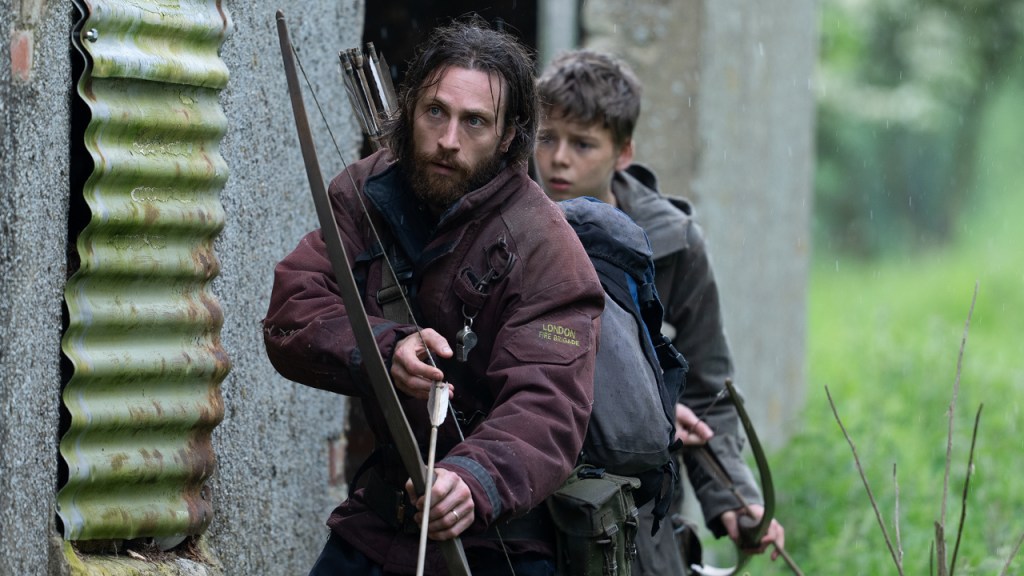
The ’28 trilogy’ is finally complete after 23 years, at least where the number of films is concerned. 28 Days Later came out in 2002 and was the perfect rejuvenation of the zombie genre, providing an unmatched grittiness, whilst being full to the brim with Boyle’s funky directing style. 2007’s 28 Weeks Later was less of a hit and really lost the momentum that the first film set up. With a clear drop-off of directing prowess from Juan Carlos Fresnadillo, and some bafflingly stupid narrative decisions, no amount of gore, action and angry zombies could save this one from being a mess. And so that brings us to the new release of 28 Years Later. With Danny Boyle returning to the helm, this has been a long time coming. Rather than feeling like an ending to the trilogy though, instead this is set up as quite the opposite. Specifically, this is a fresh start for the franchise, not held down by past mistakes and it thrives in its bold re-establishing of this world. With two more films on the way, 28 Years Later swings for the fences to create a bombastic and exciting experience that sets up what could be a fantastic trilogy.
28 Years Later brings us back to a Rage Virus plagued UK, almost three decades after the initial outbreak. The virus driven back from continental Europe, but the UK has now been quarantined and it has left anyone still there doomed to stay. Survivors have to make do with their doomed lives and scavenge for what they can. One group of survivors is those on the island of Lisdisfarne in Northumberland, who have managed to upkeep a safe village community. Separated from the mainland by a causeway, that is only crossable in low tide, the villagers live as close to normal lives as they can in their less than ideal situation. Amongst those villagers lives Jamie (Aaron Taylor-Johnson) and Isla (Jodie Comer), with their son Spike (Alfie Williams). Isla is bed-bound with an unknown illness and all Jamie and Spike can do is just help her as much as they can, as there is no local doctor to diagnose her. Most importantly though, Spike is about to go on his first venture into the mainland with his father. He needs to learn about survival and killing infected, as do most youngsters in their fallen world. However on Spike’s travels, him and the audience will notice that the infected are changing and evolving, becoming more organised and more threatening.
Not much more can be said about the plot without spoiling anything, but know that it is wonderfully executed. Spike is undoubtedly the protagonist of this film and the film serves as an unconventional coming-of-age story for him. It is about him learning to survive and discovering how the terrifying world around him works. Most of all though, it is about him becoming more of an adult and gaining independence, even at his young age. He has only been allowed to go onto the mainland at 12 years old because he can handle himself well. His father is incredibly proud of him and through that infectious love, we are also proud of his journey. He goes through a lot during this film and he is completely different at the end, no longer being a bumbling child and instead being a true survivor. Even outside of its post-apocalyptic framework though, what works about Spike, and many of the other characters, is how they convey real problems that we as an audience can connect to. Isla is dealing with very real, non-zombie virus related afflictions and Jamie’s love for her but also tired-nature towards her because of her condition is sad but grounded in reality. She is incredibly hard to be with, often confused and full of exaggerated mood swings and whilst that does not justify Jamie’s frutrations and actions, it certainly helps understand them. One of the more interesting characters is Kelsin (Ralph Fiennes) and he is shrouded in mystery that cannot be explored properly without spoilers. But his notions of life, death and the nature around him work impeccably well with everybody else’s individual stories. Garland consistently excels in depicting humanity in such otherworldly situations and much like in 28 Days Later, he has nailed it again with this new installment.
The visuals are all done with such style and finesse and that is mostly down to Boyle’s direction. Boyle’s auteur style is everpresent here and he certainly does not pull his punches when conveying his style. Action is shot in such a strange slapstic way that Boyle heavily leans into, making it just work. When Jamie or Spike shoots an arrow through the head of a zombie, there is often a freeze frame with a quick pan to really accentuate the gore and impact of the shot. Regular collaborator with Boyle, Anthony Dod Mantle, is back as the cinematographer and if anybody knows how to respond to his direction with purpose, it is him. As Mantle did with the original, the action is done with a messy, franticness that is so key to this franchise, making things feel slightly tongue in cheek with their ridiculousness but still carrying a cutting edge. It is incredible to think that a lot of this was shot on multiple iPhone 15s and it is a true innovation of digital cinemtography. The very fact that it was shot this way works in the film’s favour too, giving it a makeshift feel in the best possible way. In regards to other things visually, the zombies all look great and the sets are even cooler. Kelsin’s bone circle, for example, is chilling to look at and yet it is hauntingly beautiful how it has been crafted; a theme very much in tandem with Kelsin’s own beliefs. This is also a good example of how well the world is built and even just from looking at the forests, you are hesitant to see what horrors are lurking around in there.
Spike has already been talked about to death here but it has to be said that Alfie Williams’ performance as him is incredible, considering this is his first ever large role. He has a lot to go through emotionally as a character and Williams handles all that pressure like a professional. Taylor-Johnson and Comer are also very good, with very different performances that sell their characters so well. Comer has less to do to really take centre stage but when she does, she conveys so much, whether it be aimless anger or her more reserved and neutral states of confusion. Fiennes has a good performance for his smaller role and he is a good example of how conflicted I am with the side performances. Whilst he is consistently great, as with the other side characters, there is a lot of slight comic relief that comes across a bit much at times. This is not much to do with Fiennes itself but characters like Erik (Edvin Ryding), who just seem to change the tone of the film for a small period. It is certainly not a dealbreaker and it works more often thaan it doesn’t, but it was noticeable. This is clearly a result of Boyle’s over-the-top directing style and considering how much he does get right with this film, it is hard to even consider bringing him down a peg for this.
28 Years Later is exactly how a legacy sequel should be. It is not pinned down by fan service slop or trying to connect every single dot with the previous two films and it works so much better for it. Crucially, it takes a lot of what made the original great, whilst not directly ripping it off by imitating it. In the start of this new trilogy, we have a great film to kick it off, full of interesting characters that I am very curious to see continue their stories. Luckily, the sequel, subtitled The Bone Temple, is scheduled for January next year, as a result of both these films being made back to back. With Nia DaCosta directing and Garland returning to the writing room, this first film has certainly made me excited and enthusiastic for what is to come next. Not long to wait!

 Screen Addict
Leave a comment