
After a year that has pretty much been dominated by horror films, it was only natural that modern horror master Ari Aster was summoned to throw something of his own making into the mix. Known, of course, for the endlessly freakish and influential Hereditary back in 2018, Aster already cemented himself as a director to watch after that film. Yet his filmography afterwards has been a bold one, refusing to be tied down as a horror auteur and instead using his platform to try new things. As good as Hereditary was, it was full of crowd-pleasing aspects that were sure to fire him into stardom, particularly so when executed as well as it was. His subsequent efforts, Midsommar and Beau is Afraid, were much more polarising pieces, the latter of which deviates from horror completely, aside from a few scenes. Aster is clearly not a man who likes to be put in a box and be given labels, trying to transform each film he releases into something new, not just for the audience but also for his career. Eddington is his latest film, and once again, he follows that same trajectory with a film wildly different from his previous filmography. Adopting a modern Western-style approach, Aster has created an outright strange film that, at times, feels like a complete mess, but still manages to establish its point amidst its chaos. It will not be for everyone, much like his previous films. But it sets out with a task that it ultimately smashes out of the park due to Aster’s wild execution of his vision.
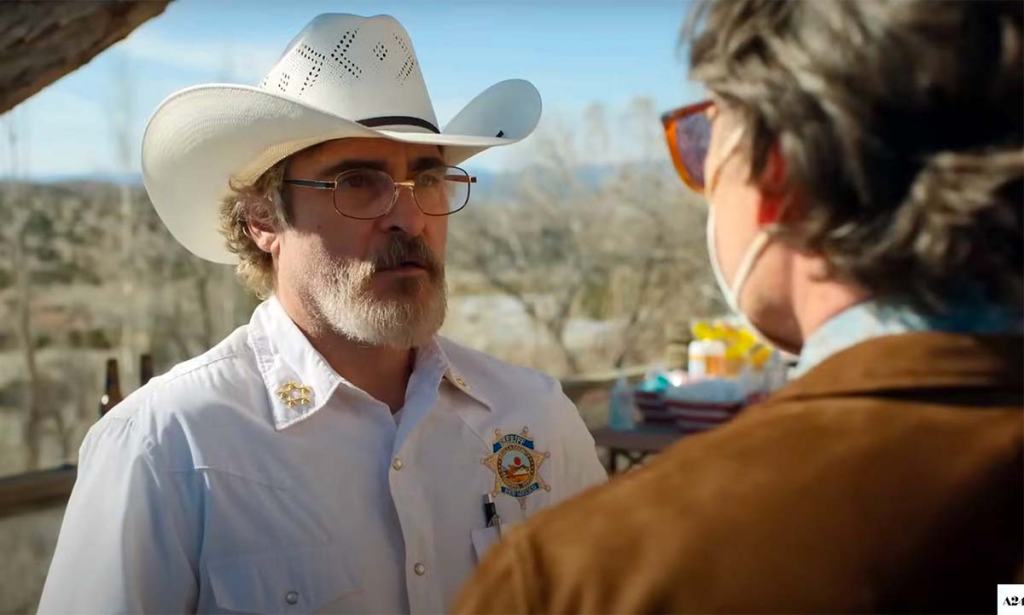
Eddington centres around a fictional small town of the same name and the growing political tensions surrounding it. Set at the start of the COVID-19 Pandemic in 2020, the film explores growing tensions of those unwilling to follow the social distancing restrictions and wear masks. These restrictions have been put in place by town mayor Ted Garcia (Pedro Pascal), who is also attempting to run for mayor a second time. Police Sheriff, Joe Cross (Joaquin Phoenix), is growing increasingly sick of the restrictions, not being comfortable with people being shoved out of shops just because they will not wear a mask. Once he notices people flocking to support him in his ideas, he also decides to run for mayor, bringing tensions between the two and Joe’s own family. His often ill wife Louise (Emma Stone) is very upset about it, and her conspiracy theorist mother, Dawn (Deirdre O’Connell), is not keen on the attention it might attract while her daughter is ill. With massive events in the news coming about, such as that of George Floyd’s killing that sparked the Black Lives Matter movement, the town becomes a massive political muddle. With protests and riots decorating the streets, and cult leaders like Vernon Jefferson Peak (Austin Butler) turning up, the film quickly displays itself as a microcosm of modern America and its often confusing political climate.
To tackle this film at all for a review is a mammoth task that almost feels insurmountable. Eddington has so little really going on explicitly for the large majority of it, and yet for the whole film, plenty is bubbling underneath its surface. This is a thorough examination of America’s political spectrum, from far left to far right, and those who flip-flop in between depending on what works for them. Of course, the main opposition in this film is between Joe and Ted, very clearly representing conservative and liberal agendas, respectively. What is remarkable is that Aster does not seem to explicitly pick any sort of side and instead pokes fun at both with lots of subtle digs. Whether it’s the left-wing tendency to come across as virtue signalling or the right-wing stereotype of bad grammar and insane conspiracies, this film has many aspects of comedy that go towards deconstructing society’s biases and downright stupidities. With the comparable degree of criticism delivered, the film does lean left when you pick it apart, but it is refreshing to not be so biased towards one side. Picking apart the sometimes performative nature of the left is legitimate criticism, and a lot of people use activism for the wrong reasons. Brian (Cameron Mann) is an interesting character as he encapsulates this problem. Specifically, being an activist to impress a girl is wrong, as it is disingenuous to your own political reading. And yet, it is still a human thing to do. That sentiment is the crux of why so much of this works. This film is insane, but nothing happens quite out of the realm of possibility, and everybody acts like people would act without heavy embellishment. It’s frankly mental third act may be pushing it a bit, but it lets all the film’s ideas come to an explosive head. All the irony of politics, the insanity of extremist groups, and the idea of doing things not out of your own belief but for hierarchical standing, or even survival, it is displayed here in an engaging way that somehow manages to tie an assortment of ideas into a cohesive package. People are generally quite selfish, even if they may not mean to be, and even if something may seem outwardly kind, there is always the slightest nugget of reasoning that they are doing it for themselves.
With Eddington‘s overflowing sea of ideas, it is impressive that Aster manages to bring it back around to make any actual sense. It is definitely the kind of film that you have to stick with to the end, as its ideas are only fully fleshed out when given the full picture. Aster’s direction also brought out some great performances here, particularly from Joaquin Phoenix, who is as good as ever. People may be exhausted with seeing Pedro Pascal on screen, but I certainly am not. While he does not do anything flashy here, he is reaching some great levels of movie stardom, and his range is becoming more and more undeniable the more he attaches himself to. Where Aster may not be to everyone’s taste is how he delivers this narrative, and a lot of it comes down to the pacing. This is quite a long film, and it certainly feels that way, mostly due to a lot of scenes dragging out a few seconds too long. By no means did I expect a film from Aster, a man who really lets scenes breathe, to have much of this trimmed down to be more snappy. However, I think it would have gone in the film’s favour, particularly when it comes to some of its more comedic aspects. Some scenes are more chaotic and move faster, like the protest scenes, and they succeed in a good flow of information while remaining entertaining without overstaying their welcome. You trim the fat from this film, and it may make it more digestible for more people, although we all know that Aster is not necessarily bothered about that. At the end of the day, the fact that all his ideas come together as well as they do at the end may warrant that slower build-up, so it is just a matter of the audience’s own taste in how they respond to this style.
Eddington is not a flawless piece, but it is certainly one of the more interesting films I have seen all year. Most importantly, it shows Ari Aster growing to be a bold filmmaker who, once again, clearly has a very specific vision for each of his projects. He is no longer a filmmaker who is dedicated to pleasing a crowd, and instead is showing himself to be full of wild ideas that I sincerely hope do not slow down. After a year of great horror releases, it is ironic that a more horror-centric filmmaker would make a completely different type of film. If you compare any of Aster’s films to Eddington, you will not only see how far he has come in terms of scale, but you will also see how in tune with exploring the human mind he is. Many mock Aster for making mental films instead of going to therapy, but all his films are real think-pieces that come across as a venting exercise, not to their detriment. Whether it is more intimate and personal feelings like grief, or broader strokes like the state of the political landscape of the USA, Aster handles all these emotions with real purpose, and I have no doubt his career will carry on to do so.



 Screen Addict
Leave a comment