
Kogonada is an interesting filmmaker whose roots go back to his own love and deconstruction of film. In his early career, he made lots of video essays on various TV shows, films, and directors. Being commissioned by the BFI for their ‘Sight and Sound’ magazine, he did lots of work for them and also the Criterion Collection. This is a man well-versed in film, and his background as a film content creator shows both his love and broad knowledge of the art form. His jump to directing has been one of great success, with Columbus (2017) and After Yang (2021) being two very different, but still highly praised projects critically. Since, Kogonada has moved from his more independent filmmaking to be enlisted by Sony to direct A Big Bold Beautiful Journey, starring previous collaborator Colin Farrell and also Margot Robbie. Falling in line with his rather existential and human filmography, this seemed like a match made in heaven. The internet often uses a term for some films, and it comes from Family Guy, of all things. Peter Griffin says the phrase “It insists upon itself” to describe something, and whilst that may not sound like it really means anything, I think this film perfectly encapsulates what that strange phrase means. Just from the trailer, you can see exactly what type of film this is going to be: an overly sentimental and emotional film, trying incredibly hard to be profound. And after watching it, that is exactly what it is, with its hamfisted and on-the-nose examination of life coming across as just being incredibly insistent upon itself, thinking it is saying much more than it actually is.
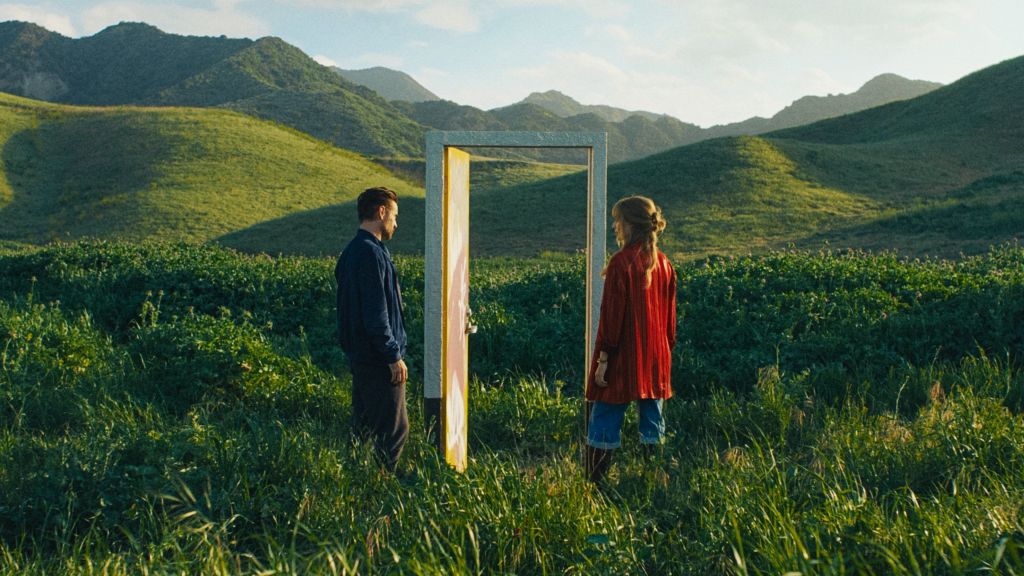
A Big Bold Beautiful Journey follows David (Colin Farrell), who needs a car to go to a friend’s wedding. He goes to a strange car rental company that seems rather suspicious. In a huge empty warehouse, two cashiers (Kevin Kline and Phoebe Waller-Bridge) sit and beckon him over. They quiz him on his life, rather strangely and invasively, before sending him on his way, insistent upon taking their specially made GPS for the car. At the wedding, his friend nudges him towards Sarah (Margot Robbie), who is also single and at the wedding by themselves. They both play hard to get in typical fashion, but there is something tying them together. When they both get in their cars to go home, their GPSs both ask them the question: Do you want to go on a big, bold, beautiful journey? They both have nothing to lose, so they say yes, and it leads them to coincidentally both go to the same place to get a burger (unashamedly sponsored by Burger King). Clearly on the same trajectory, they both get into David’s car together, and they begin their adventure. Arriving at different spots with literal doors to their past waiting for them, they will go on a journey exploring both their lives and seeing what that may mean for their futures.
Immediately from the premise, you may see how this could possibly be on-the-nose with its approach to being a reflective piece on life. It may possibly seem like it is riffing off its obvious leanings, but I assure you, this is self-serious and therefore completely ridiculous in its execution. Too many of its highly emotional scenes just feel really processed and not raw enough to be effective. There is a moment at the beginning of the film where David is trying to get into the car rental place, where the door is difficult to open, with an incredibly specific thing required to do so. Phoebe Waller-Bridge’s character says something along the lines of ‘what I’m trying to say is: doors are tricky’. Considering I already knew the concept of the film, I almost let out an audible groan at this line. To a tee, it nails the problem with this film, droning on, not getting to the point, and then being forced and clumsy when it does. A lot of the dialogue is similar to this, with a gross unnaturalness that makes the deliveries of each line not land. To put it best, they feel like lines that were meant to be put over the trailer only, rather than actually having a place in the story. Colin Farrell, uttering ‘the most beautiful places make you feel the most alone,’ is so stiffly put, and even if Margot Robbie’s character teases him for saying it, that in itself tells you the line is awkward and does not work. Some clever dialogue may balance this out and make the lines stand out less, or even recontextualise them as feeling more satirical, but in isolation with not much else intelligent to lean on, it shows as a major weakness of the film.
Whilst the idea of this film is obviously trying to be overly profound, there is a sweetness and charm to its world. It is full of whimsy and sometimes ridiculously so, but there is a commitment to that whimsy that is quite enjoyable. Firstly, the film does look gorgeous consistently, bursting with colour often, and being shot very competently. This may be one of the rainiest films I have ever seen, but it does use this to good effect, with there being a plot reason why. Without explicitly stating it, the world has a vibe that is similar to that of The Truman Show, grounded in an artificial fantasy that echoes the real world, and yet cannot be. The tech of the GPS is incredibly simplistic, but in a cool retro kind of way, and the navigator voice is so floaty and not robotic like you might assume. Even without the doors to their lives, this feels like a world that is centred around David and Sarah, existing in a dreamlike bubble. There is one moment where they come together, and the rain just stops around them, without being in one of their doors, further enforcing this idea. Experimental weirdness like this can be hard to seem convincing, but I think it is executed rather well here. The only real issue that makes these ideas fall apart comes down to Colin Farrell and Margot Robbie’s uncomfortable absence of chemistry together. It is hard to be sold on a crafted simulation for the sole purpose of two people getting together when the two in question do not work together very well. Their performances individually are not bad at all, quite the opposite, but the bad dialogue in particular just stops them from ever seeming like a convincing couple. The characters themselves do not ever seem to have anything in common with each other, or even share many nice moments. It is all just fast-tracked lazy romance, that aside from a couple of threads to connect them, does not quite come together.
A Big Bold Beautiful Journey is an average, relatively easily digestible romance that only just about functions. It is not a disaster of a film, but its worst elements are too prominent to let any of its more interesting ideas shine. The romance feels a bit forced, the dialogue is lazy and preachy for its cause, and as a result, the story is delivered with zero finesse to make it memorable. It is endlessly pretty to look at, and it has some fun concepts for its world, but there is nothing stellar in this package enough to pull it out of the depths of mediocrity. I fully believe this is not the film Kogonada would have wanted to make, and with this being helmed by Sony, it is pretty obvious who got a lot of the creative control. When you have a literal Burger King advert in the first act of the film, that tells you all you need to know about what studios care about, churning out a film that could have been good with proper attention, just to get it out the door and hope for a profit.


 Screen Addict
Leave a comment