
When I reviewed Atomfall earlier this year, I praised it for its respect for the player, in the way that it allows them to forge their own journey without an onslaught of markers and quest descriptors telling them where to go. Modern gaming can be exhausting due to the abundance of handholding from the developers, shepherding us along our adventures rather than letting us live and breathe them. There is nothing worse than racking your brain for the answer to a puzzle, only to then be nattered unwarranted hints from the protagonist or your companion. It ruins your immersion in solving these problems yourself, and you can feel the developers’ hand on your shoulder, trying to give you the push that you neither want nor need. The same can be said for things like waypoints and quest markers, often cluttering your User Interface with big, ugly symbols. Ubisoft has always been one of the worst offenders for this sort of thing, even going so far as to clutter the screen even more by literally showing the controls on screen during gameplay. Games like Atomfall and now the newly released Hell Is Us respect the player and their own agency. Even with the many things that Hell Is Us gets wrong in terms of combat, an over-reliance on lore, and a dull progression system, I will look upon it fondly purely for what it does for mission design and making the player be fully in control of their experience.
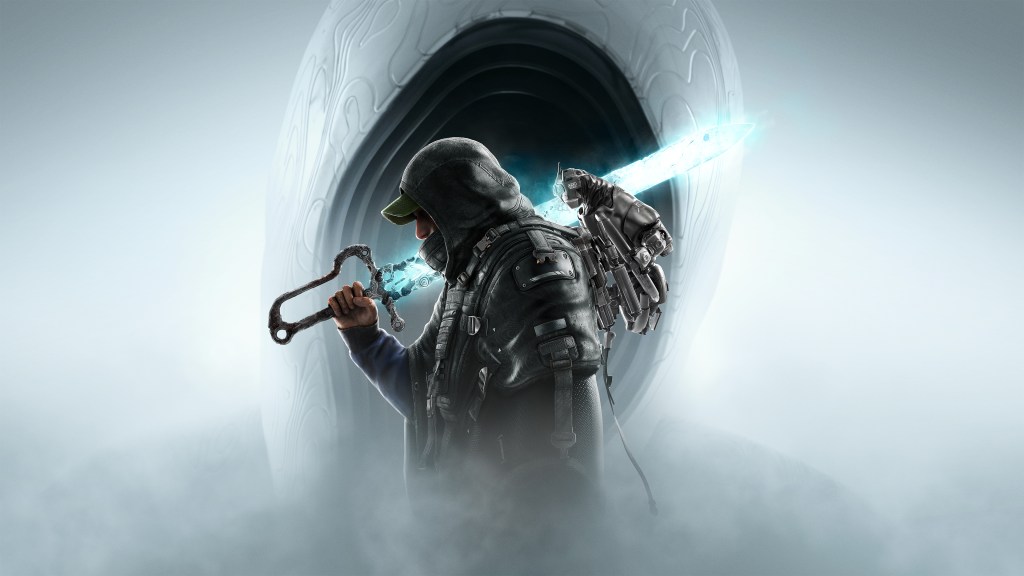
Hell Is Us is an action/adventure game set in the fictional country of Hadea, which is currently in the midst of a brutal civil war. Divided by devotion to different deities, the country is becoming ever more desolate every day, with civilians being murdered just for their beliefs. You take on the role of Remi, a soldier who has gone AWOL from his post as a Peacekeeper for the Organised Nations (ON). This was all pre-planned, just so he could infiltrate Hadea and find what happened to his parents. Arriving in the Senedra forest region, Remi discovers that the country is rife with strange, humanoid monsters that are established as Lymbic entities, there as a result of a world-altering event called the Calamity. He learns of an organisation that his father was a part of called The Vigil, which had the responsibility of quelling the Calamity and therefore stopping the Lymbic entities. In the country’s violent disorder, it has been left unchecked, with The Vigil scattered and fractured. Remi is tasked with travelling the wartorn country to try and gain entry to the Lymbic Forge, a Vigil facility that holds the key to stopping the Calamity. On this journey, you are left to your own devices, having to pay attention to the world around you in order to get the information you need and reach your goals.
The approach to world and level design is by far the best thing about Hell Is Us, and it certainly justifies its existence through this alone. This world is very reminiscent of our own and yet also very strange. A great deal of care has clearly been taken to achieve the looming atmosphere in all of this game’s areas, with its eerie ruins and desolate towns being perhaps the most evocative. Juxtaposing these two types of area really builds a lot of dimension to the world. All the random clashings of strange, lonely ancient structures of a bygone era, advanced tech of a future one, and more familiar and contemporary imagery somehow blend together in a way that does not feel like a mismatch. There is a lot of lore, though, with so much to digest that it can leave you feeling a bit lost in the thickness of it. It can perhaps rely on it too much to carry the experience, but I am sure some people will eat it up, trying to learn everything that has happened. Feeling like a fantasy, and yet something close to the world we live in, especially with its echoing of real-world horrors, Hadea is always interesting and intriguing to explore. The levels and quests set within this world are equally engaging, with lots of clear inspiration and their own innovation as well. Hadea is split into different areas, all acting as semi-open world hub areas that are filled with their own NPCs, dungeons, and a full interconnected environment. Puzzles are everywhere, too, and while they won’t have you sitting there for hours, they are no pushover, leaving you feeling giddy and pleased with yourself after working them out. Borrowing a lot of overall level design from that of Dark Souls, it also has elements of Resident Evil or even point-and-click adventures. Many of the NPCs have wants and needs that you have to pay attention to, and if you find what you think they need, you can give it to them. For example, I went into one room and found a coat. I did not think it meant much, but then a bit later on, I found a lady who wanted to disguise herself and cover up her soldier uniform, a task for which the coat worked a treat. Finding items and finding a use for them is a simple system, but it works so well, and with you often travelling back to the same areas, you will find yourself being able to do more later on, giving the game even some Metroidvania leanings. It is immensely satisfying to help NPCs by coincidentally having exactly what you need, but nothing feels quite as good as finding a key that you have been searching for what feels like ages.
As neat as this approach to level and mission design is, it has less weight when you realise the reward for doing these tasks is meagre, to say the least. The progression system and the combat to go with it are incredibly bare bones, and it does suck the joy out of playing the game at times. As far as the rewards for exploring and doing tasks, most of what you will get is stuff that will help during combat, namely new weapons, modifications for those weapons, and your drone, and then small random consumables. Weapons, and pretty much everything for that matter, have a certain type that can be rage, ecstasy, grief, or terror, all with their corresponding colour. This is only really important when it comes to the glyphs you are selecting for your weapon, of which you can only select if they match the same type as your weapon. By collecting these glyphs, drone modules, and weapons, this is essentially your only sort of progression, which can be quite dull. There are different weapons like the standard sword, twin axes, or a greatsword, but they all feel quite similar. Upgrading them is purely just a matter of numbers going up, and there never feels like a noticeable difference when using them. It does not help that the combat itself is so clunky and unsatisfying that you will likely want it to be over as soon as possible. It employs a soulslike action/RPG approach, although it is much more forgiving for how much you heal and how much damage you do. However, it pales in comparison to the sleek design of the systems they are so clearly aping, and even things like dodging just feel so off. Glyphs and drone modules act as cooldown abilities that spice things up, but there is not a wide variety of them, and most of them are useless. Enemies only come in a handful of types, too, which get incredibly boring and tiresome to fight, especially towards the third act. Somehow, the worst of all, though, is the boss fights of which there are only two, and yet they still leave a lasting impression on how terrible they were mechanically. Whilst this is not the type of game people will flock to for the combat, this is not a case of combat being used as a pacing mechanism. It is a full-blown aspect of the game, and when it is as half-baked as this, it leaves a slightly sour taste in the mouth when consuming the overall experience.
Hell Is Us is a solid experience, and even with its shortcomings, it does not feel ruined by them. Its confidence in the player alone to explore this world and let them take everything in is a fantastic approach to designing a world. Where I thought its lore-reliance was a bit overwhelming, many will gladly let themselves be swept up in that, so that is down to personal preference. The story the game tells is nothing stellar, but it is worthwhile purely to act as a vessel for the player to move through the world. It does help that, in the little tidbits of story we get, Remi is voiced by Elias Toufexis, famed for his role as Adam Jensen in the modern Deus Ex games and owner of the coolest voice ever. Even if I think everything related to combat was lacklustre, I would still say I enjoyed my time with this. If there is a sequel, as it alludes, fine-tuning the combat and taking the same world and level design approach could be a recipe for great success in the future.


 Screen Addict
Leave a comment