
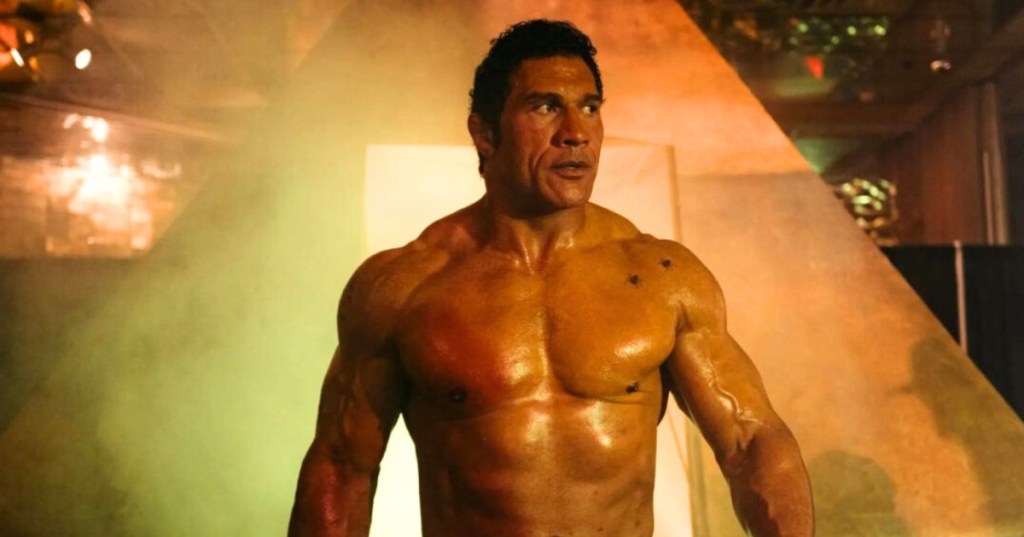
Sports films are generally a tired formula. A grizzled veteran steps back into the fold, or a hotshot rookie is whisked away into a world that he thought he knew everything about. They start off winning, thinking they are truly the best to ever do it, only to be massively knocked down a peg by their first loss. They grovel a bit, then get straight back to training and working hard (cue the Rocky training montage music) and ultimately come out on top for their final fight. They are predictable; everybody generally knows what is going to happen, and they’re generally only carried by star power, snappy dialogue, or just oozing style. Similarly, Dwayne ‘The Rock’ Johnson’s career has been one of banal predictability, with no real meaning whatsoever. I myself see a film he is in, and immediately know he is going to be the typical strong man protagonist who is good at everything. He quite literally had a clause in his contracts where he could not lose in his fight scenes, and if that does not show unapologetic egomania, what does? The marriage of these two things has resulted in The Smashing Machine, a sports film starring Johnson in a more serious acting role. Johnson himself actually feels like an actor in this, showcasing much more than his typical boisterous bravado. However, even with some welcome deviations from the sports formula, its character drama can feel half-baked, leaving a lot of the film to feel rather pedestrian and sometimes even dull.
The Smashing Machine stars Dwayne Johnson as famed UFC fighter Mark Kerr, one of the original pioneers of the sport. It shows his rise to join the competition, starting off with his wrestling debut at a tournament in Brazil, and then going straight into his breakthrough in the UFC. It shows his relationship with fellow UFC fighter Mark Coleman (Ryan Bader), bringing him into the fold and showing him the wider world of Mixed Martial Arts. Underneath all the glitz and glamour of combat sports stardom, the film also deals with the turmoils and darker troubles that brew underneath the surface. Triggered by his first-ever unexpected loss, Kerr’s substance abuse of painkillers gets him into a downward spiral. His relationship with his girlfriend, Dawn (Emily Blunt), is also not sunshine and daisies either. His refusal to let her into his mind and understand everything he is going through leads him down a dark path of abuse to himself and those around him.
Praise has to be given to this film for its portrayal of the UFC, showing lots of its inner workings, its controversies, and, of course, its brutal combat. As someone who knows very little about the UFC, it was a welcome sight to see all the politics of the sport, things like the rules disputes and changes, or the stories that are trying to be told with each fight. It is all explained well, and does not treat the audience like an idiot by explaining it all like talking to a baby. I certainly come out of this with a greater respect for the sport, and I am definitely more intrigued by it than I was before. UFC’s sheer brutality has always been the thing that has surprised me about it, and there was an interesting touch point in this film talking about its controversy and whether it should be banned. When asked whether the fighters hate each other, Kerr says ‘absolutely not’ and that is the perfect case for why it is a sport rather than just needless violence, like many suggest. The fighters respect each other, and the contest itself is purely to test which of these ancient ways of fighting has been honed the best by the fighter, and there is an art to that. Fight scenes are shot in a more reserved way and less cinematically than you might think. Comparing the fight scenes of Creed III, for example, which Michael B. Jordan specifically cited as anime-inspired, they are great, but they feel cinematic and more dramatised. These fights are quick, brutal, and they let the combat speak for itself, rather than flashy camera or editing tricks. For this more grounded and visceral experience, this was the right decision, and it definitely is one of this film’s greatest strengths.
Where the film collapses is its more character-focused drama, and this does not help when it is the main driving force of the narrative. As well-done as that UFC side of things is, this film is clearly much more bothered about Kerr’s relationship with Dawn, his friends, and his mental state during his career. Having lost his first fight, his world comes crashing down, full of newfound self-doubt and depression. His need to lock in and focus on his fight upsets Dawn because she cannot see him while he is building up for a fight. She is fighting for the human side of him, and when he is juicing himself up with opioids, trying to quell any sense of pain to turn him into the titular machine, he is losing his humanity. There are lots of references to pain being the only way to get what you want, and it shows that his route of drug abuse is not getting him to where he wants to be. The trouble with all this is, it does not ever feel like these ideas are fully followed through, and it is all in a mixing pot that just has not been stirred properly. Dawn’s character is really quite dull and is all over the place when it comes to the various conflicts and heated arguments, seeming to care about Kerr one second and then not the next. It feels like there are missing pieces to her full story, as the gaps between each scene make her just seem incredibly bipolar and turning on a swivel. Their relationship is very confusing, with not many real showcases of them actually loving each other and just fighting instead. It is not very well written, and considering their story is at the forefront of the narrative, it leaves a gaping hole in the entire thing. Kerr’s substance abuse is seen as quite a big deal at some points, but then at others, it is just quietly swept under the rug and forgotten about. It does just feel like there are gaps in the whole thing, and with its incomplete feeling story, it makes the rest of the film suffer.
The Smashing Machine is not great due to its poorly written character drama and half-baked feeling, but there are still some worthwhile things to enjoy and take away from this film. Its exploration and portrayal of the UFC is quite interesting, and if anybody is curious about the UFC to any extent, this might be exactly the sort of entry-level delivery of information that they might want. Perhaps the biggest talking point of this film is Dwayne Johnson taking on a serious role, and whilst I do not think he was quite brilliant, this is far and away his career-best performance, though the bar is rather low. Even if he was rubbish in this film, I would still appreciate the attempt from him to try and branch out from his usual ways, trying to really immerse himself in a role as opposed to playing himself. Thankfully, he is good, though, and so is everybody, for that matter. While this film is probably only just okay, I am glad I watched it, and that it will be remembered as hopefully the first film where one of the world’s biggest movie stars actually decided to act.

 Screen Addict
Leave a comment