
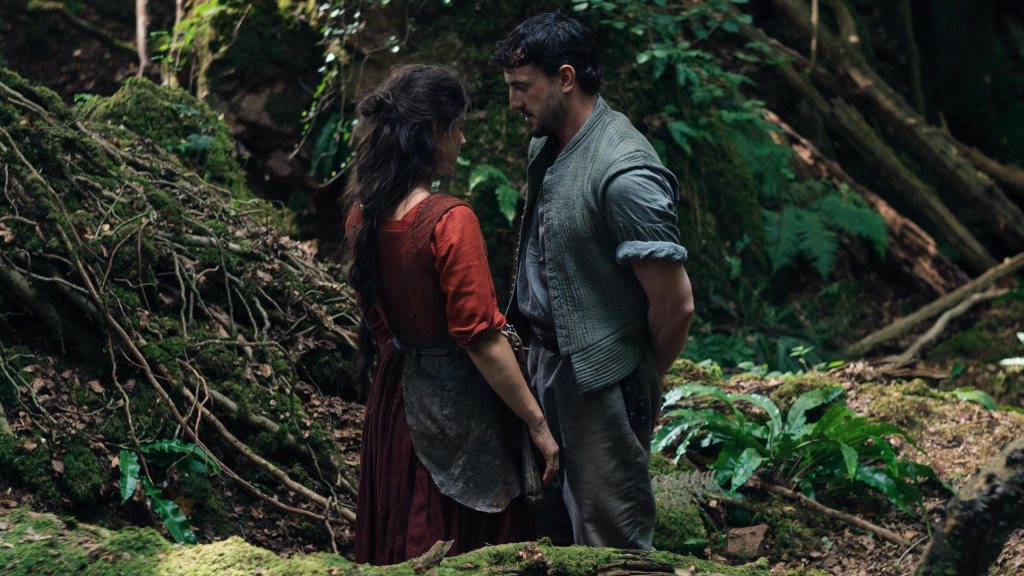
Chloé Zhao, as a director, is an expert at letting her films breathe and showcase true emotion whilst doing so. There is a quietness to her work that lets those emotions thrive during slow buildups and scenes that have no real urgency in ending. I have not seen her directorial debut of Songs My Brothers Taught Me (2015), nor The Rider (2017), but when her work with Nomadland (2020), and even her Marvel effort of The Eternals (2021) showcases it, clearly, this is integral to her directing style and her characteristics as an auteur. Those earlier films are cited as having that slow-burn, emotional style anyway, so it is clear the foundations of her style were built during her earlier work. Though I do not like The Eternals at all, I find it impressive that she even seemed to have any inflection of her style in there, as we know what working for a big studio can be like for a director. However, coming fresh off the masterful Nomadland may turn a few heads and allow a bit more control. When hearing of the buzz about her recent venture, Hamnet, I was skeptical as to whether Zhao would be able to tenderise her filmmaking off the back of her big-time Marvel gig, but still give a Shakespeare project the necessary spectacle it deserves. I had the privilege of seeing this at another London Film Festival screening, and it absolutely blew me away on every front, sailing into my best of the year rankings.
Hamnet is based on the book of the same name by Maggie O’Farrell, which depicts a fictionalised account of William Shakespeare’s family life, including his marriage to his wife, Agnes, and the birth of his children, Susanna, Judith, and Hamnet himself. Jessie Buckley stars as Agnes, as the story unfolds mostly from her perspective. Dealing with her reputation as an outcast, with her being thought of as a forest witch due to her mother, we see her first meeting with William, played here by Paul Mescal. They meet in the forest, where Agnes is flying a hawk she has tamed, and William is enchanted by her, sneaking off to see her against his family’s judgment. William currently tutors local children, but seeks his higher calling, often at his desk, where he writes drafts of the stories he will one day assemble. However, here, their love is the focus, and their budding romance sees conflict with both their families. Though when William starts to go off to London with Agnes’ blessing to find his way, his growing success sees him away more often and absent from Agnes’ life, and also that of his growing family. When times get difficult, including the death of Hamnet (Jacobi Jupe), on which this book is based, Agnes struggles even more and often resents William for his continued absence.
Hamnet‘s biggest triumph is that of Zhao’s honing of her own style, finding a story that warrants her slow, emotive, yet grand style. The emotion oozing out of this package is impossible not to get swept up in, feeling every single beat as if it were part of your own life. Zhao’s direction lends to the slow and floatier cinematography by Łukasz Żal, which makes each scene more ponderous and thought-provoking. Zhao’s own editing imprint is clear, knowing how to string the cuts together in a way that does not disrupt that floatiness, and therefore the emotion that it carries in its flow. Every scene is important, pitch-perfect to serve each character’s own personal values, their key relationships, and the more oppressive conflicts that come their way. This is in tandem with the film’s overall seamless flow and neat pacing is the sign of a great edit, one that has been absolutely nailed. Particularly towards the end, the editing, the cinematography, and all aspects of Zhao’s direction fire on all cylinders, creating an almost suffocatingly emotional climax that I doubt left any dry eyes in our screening. Contrary to what I have heard from some reactions, all this brewed emotion feels natural and not remotely in a manipulative, Oscar-baiting way. It has the rawness of Zhao’s previous work, Nomadland‘s more emotional scenes being a great comparison. The same can be said of the performances, which feel incredibly raw and are all excellent. Jessie Buckley, in particular, is an absolute knock-out, and I cannot see a world where she is not nominated for Best Actress, potentially even winning. Paul Mescal is almost as good, and his Oscar campaign, rumoured to be for Supporting Actor, makes perfect sense considering his screentime. The biggest surprise, acting-wise, is Jacobi Jupe for Hamnet, who gives a profound and wildly diverse performance for someone so young. Capturing innocent childlike joy one moment, and then a much more grown-up and devastating sadness the next, he is magnificent.
The strength of Hamnet‘s writing is another reason why it soars as high as it does. Its main depiction of grief is so well explored and painfully human, showing its devastation in different ways via how Agnes, Susanna and Judith, and William himself deal with it. The centrepiece of this story is Hamnet’s death. It is the reason this book exists, and the book puts forth the argument that it is also the reason for one of Shakespeare’s best works, Hamlet. Agnes is obviously in immense pain, and that leads her to be upset with William for his absence. But even before that, she is basically in denial. With the birth of Hamnet and Judith, some difficulties seemed troubling for the babies’ health. But Agnes’ refusal to give up saw her eventually wake. This past experience results in the heartbreaking refusal to let go of Hamnet, and that somehow it will all be ok in the end. This relentless clinging on is explored fully, and the arc is portrayed in such a wonderful way, with that big emotional climax offering the appropriate crescendo for that character thread. William’s depiction during all this is equally interesting. Early on in the film, it is clear that he uses writing as a sort of therapy to overcome all the problems he is facing, namely that of his family conflict early on, and this immeasurable loss. His need to go straight back to work and leave Agnes seems like a selfish one, but it is truly the only way he has learnt to deal with anything like that. This is especially hammered home during that climax, which depicts Hamlet as the result of all that distraction and the pain that came with it. There are a lot of lines from Hamlet along with little references to other Shakespeare works, but none of these feel cheap. They work perfectly with these character arcs, often being used at extremely effective points. Anybody saying these lines are cheap and just there to appease Shakespeare fans clearly was not paying attention, as not once did any of it feel awkward or out of left field. This is written with extreme confidence, building the character drama around the foundations of Hamlet, and with echoes of other famous Shakespeare works, without ever feeling clumsy or too on the nose.
Hamnet is a masterful piece of cinema that is, without a doubt, some of the best this year has to offer. It is far from just a simple tearjerker, like it might seem, and is instead a very raw and beautiful depiction of some of life’s greatest tragedies. This film does feel very Shakespearean in the way that this tragedy is constructed, with a classical feel that almost unfolds like a play. As someone who does not know enough about Hamlet, this has certainly made me curious to explore it beyond just the famous quotes. I went with my sister, who deems Hamlet to be her favourite work of fiction ever created, and if you will not take my endorsement on this one, then perhaps hers will be more impactful. For how much justice this does towards Hamlet, platforming it and Shakespeare himself as a pillar of art and expression that we know today, it was very interesting to see this from the perspective of someone so familiar with his work, as opposed to me, who is a complete rookie. Whether it does any of this or not, it is still a fantastically crafted film, full of confidence and style in the way that it has been directed and written. Zhao has delivered another masterpiece for me, and I am keen to explore her earlier work thanks to this.

 Screen Addict
Leave a comment