
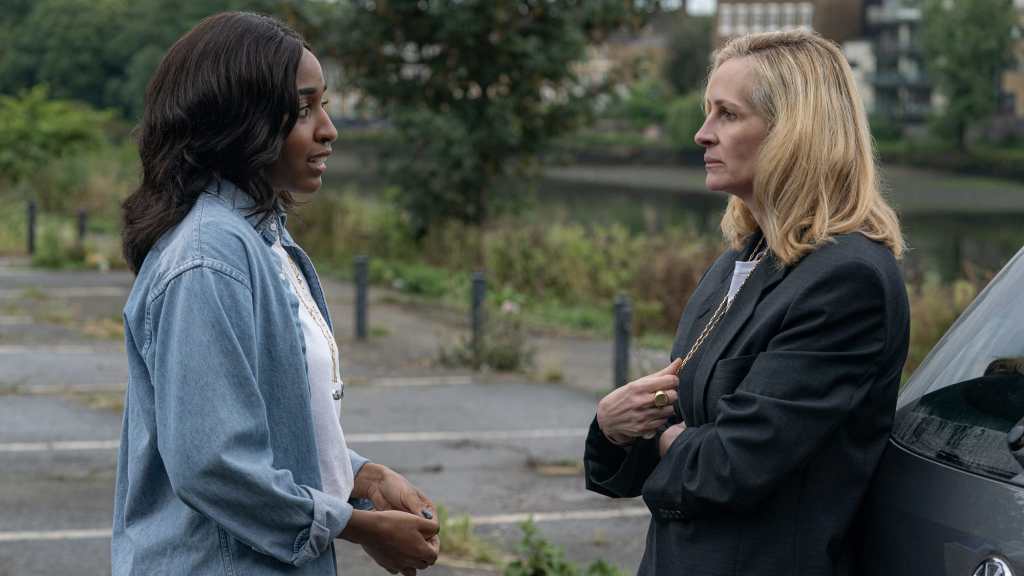
Luca Guadagnino’s directorial work has been varied in terms of its critical acclaim through the years. A great deal of his earlier work struggled to hit the mark and was generally received negatively, like The Protagonists (1999) or Melissa P. (2005), and it took a while for him to really hit his stride. I Am Love (2009) saw one of his first great successes, and it seemed from that point, he had found his forte. In the past decade, he has become one of the bigger directors to watch, his work often providing lots of thought-provoking themes, wickedly spun romances, and some of the most stylish cinema you can find. I have not seen nearly enough of his films, but of the ones I have seen, I have loved them. Particularly, Challengers (2024), which was one of my top films of last year, showed Guadagnino at the peak of his powers, engineering an enthralling love triangle that somehow ended up making Tennis, of all things, quite sexy. This brings us to the present, where Guadagnino has managed to churn out yet another film, and it has not gone down quietly. With his acclaimed direction and its massive fronting cast of the great Julia Roberts, Andrew Garfield, and Ayo Edebiri, After the Hunt seemed like it was going to be an absolute hit. However, this film has landed in a much more polarising position than predicted, targeting heavy, complicated subjects and seemingly not fully taking any sides.
After the Hunt stars Julia Roberts as Alma, a philosophy professor at Yale University, who has returned to teaching after a medical absence. Married to a therapist named Frederik (Michael Stuhlbarg), the two host a party full of students and teachers that they know. Among the guests are Hank (Andrew Garfield), a fellow teacher and best friend of Alma, and PhD student Maggie (Ayo Edebiri), who is seen as Alma’s teacher’s pet by many. When the party comes to a close, Hank and Maggie stumble out playfully drunk and disappear, which Alma does not think anything of. However, Maggie confides in her later on that Hank started to get very touchy and oppressive, ultimately sexually assaulting her at her own home after inviting himself in. This throws Alma into turmoil, appalled and yet slightly unsurprised that Hank could be capable of this, but also not fully sure whether she believes Maggie. Alma’s past similar experiences echo in her mind, scrambling her view of the situation and all but leaving her stumped. Frederik has always been unsure of Maggie and Alma’s friendship, too, thinking they were much too close and that Maggie wanted more with Alma. With her health also getting her down, Alma is torn about the situation, struggling to separate her personal feelings and experiences from what could be a very real situation.
This is an incredibly tough film to pull apart due to its subject matter, and the film’s own attempt at dissecting the subject feels very murky. Many have said that this film is fence-sitting in its approach towards things like MeToo and believing victims, but that was probably the intention. This film says next to nothing substantial about this subject, not damning victims, but ultimately not fully damning Hank as the assaulter either. Though this is because we see all of the film from Alma’s point of view, and her past experiences and own personal values and relations stop her from taking a side. Her long and winding friendship with Hank is a hard thing for her to just completely cut off, just because a student said so with no other evidence other than her word. Maggie’s word should be enough, but due to her own allegiance to Hank, she struggles to accept it. These feelings only get murkier when Alma’s own experiences are revealed later on, reinforcing this stance that she takes. Alma also relates Maggie’s background and values to the case, not being sure if she is just an attention-seeker. Due to her rich family, she has never been told no or not gotten what she wants. This makes her think she may have spun the whole ordeal to make Hank look like the bad guy, especially when Hank has allegedly called her out for plagiarism in her work. All of these things are those horrible thoughts that linger in the back of the mind when cases like this come about. Believing victims is an incredibly important thing, but this weighing up of contexts is a natural intrusive impulse, trying to deduce what definitely happened. As Alma herself says in the film, “not everything is supposed to make you comfortable”, and that is the essence of what the film is trying to say. Alma is not correct; she is clearly a very flawed person, and these are merely her thoughts and feelings whilst dissecting a case that is very close to home for her. Showing these things is not supposed to make you comfortable at all, and although it could have been handled in a less muddled and messy way, this film does propose an interesting perspective.
For all the debate that After the Hunt brings in its writing and subject matter, the opposite can be said for how well-crafted this film is by Guadagnino. Firstly, the cinematography is quite animated for such a tight, intimate, and claustrophobic film. This is obviously a conscious choice to reflect the constant turmoil and back-and-forth thinking that Alma goes through. The aggressive zooms that frequently occur are inherently accusatory, which is obviously very fitting for the type of film we have here. It is edited quite slowly and lets scenes breathe, possibly too long sometimes. But broadly speaking, this does work for many of the scenes that just linger on one big revealing conversation. The lack of continuous cuts makes it feel very confrontational and purposeful in its engagement with these scenes, and it works well. Unfortunately, there are a few scenes that do feel pointless, or just say the exact same thing as before, and this impacts the pacing negatively. This is already a very long film for what it is, so it certainly does not help when it starts to drag. Luckily, the thing you will never get tired of is the performances, which are consistently brilliant. The star is obviously Julia Roberts, who is wonderful to see on screen again, and in such a challenging role. She perfectly portrays Alma’s conflict and her quiet pain that brews below the surface, delivering a wonderfully subtle performance. Andrew Garfield and Ayo Edebiri are also brilliant, and Michael Stuhlbarg manages to give you a lift every time he is on screen, with his eccentricities and sassiness. One particular scene where he is annoyed at Alma, and he keeps coming through the swinging door of the kitchen very passive-aggressively, whilst Alma and Maggie are talking, is so funny and a great light relief moment in what is otherwise a quite bleak film.
After the Hunt is not great, but I do admire the attempt to deal with the complexities of this subject. Its approach does feel very muddled and messy, and even if that is the point, it can be hard to follow and get fully invested. Guadagnino’s own influence in trying to tie this all together largely works, but it does feel like he is biting off more than he can chew, because this is a subject that needs to be nailed. Particularly where the runtime is concerned, it has to be edited to waste no real time, and the script has to be sharp, and the latter is not quite there. The performances really do elevate the whole package, but it only slightly lifts it out of the pit of mediocrity that hangs dangerously close over. This film is just fine, but to make it any more than that, it needs to have more of a point, rather than just all the pieces of one that come to no real conclusion. Make the audience come to their own conclusion, of course, but there does need to be more substance here.

 Screen Addict
Leave a comment