
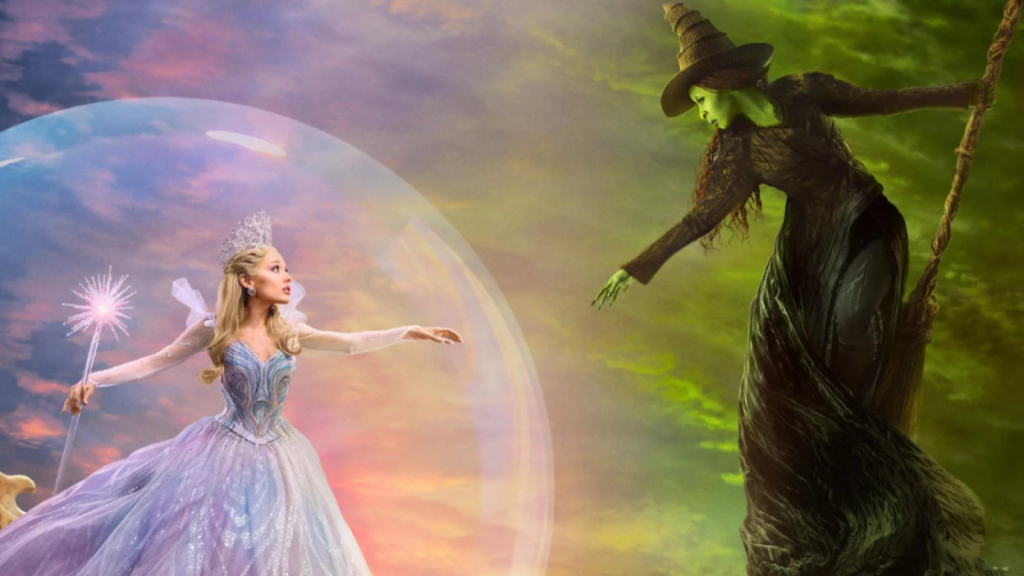
Wicked and I have a very conflicting relationship, both on stage and screen. It was the first (and one of the only) stage productions I have ever seen, and that is an art sector I know next to nothing about. The Wizard of Oz was a beloved classic in my house growing up, serving as the perfect Sunday afternoon wind-down film after a much-needed roast dinner. This led me and my family to watch Wicked on stage in London, and with my young self not being particularly a fan of musicals, I was not really looking forward to it. My mum still quotes me to this day as I walked out of it and said, ‘That was not as bad as I expected’, yet it was never a story that stuck with me, nor enticed me to watch any more stage productions. When the film adaptation was announced, I was curious and yet still rather pessimistic about it. My main issue with the story was always its retconning of a classic, feeling the need to lore-dump on a ‘villain’ origin story that could have just been left untouched. There is an obsession with making villains nowadays that have something to say and need to justify why they did the things that they did. Sometimes it’s nice for the wicked witch to just be wicked, a cackling evil that mirrors the purity of Glinda and Dorothy. Still, with the first film’s technical problems, it managed to sidestep any entanglements with Dorothy’s story and functioned well as its own separate thing. Its songs were great, the numbers supporting them even better, and it was a solid, inoffensive musical film that happens to feature characters from The Wizard of Oz. However, the second act of Wicked, the basis of the newly released Wicked: For Good, has often been criticised for its much weaker songs and even worse narrative. This new film, unfortunately, follows those same problems, bending over backwards to make sure everything in The Wizard of Oz comes to fruition and, in doing so, feels sloppily put together. It probably could have been worse, but ending the first film on such a high note, only to be met with this to follow, the whole package now feels rather flat.
Wicked: For Good is set a few years after its predecessor, and Oz is still being ruled by the not-so-wonderful Wizard of Oz (Jeff Goldblum). The Emerald City is still as bustling as ever, but there is an anger that has brewed, and it is all thanks to the Wicked Witch of the West, Elphaba Thropp (Cynthia Erivo). Under the Wizards’ rule, Madame Morrible (Michelle Yeoh) still stirs discontent and propaganda against Elphaba, coining that wicked title that is echoed throughout the land. Glinda the Good (Ariana Grande) is also still in The Emerald City, keeping quiet under the regime and not spilling the Wizard’s deception about her long-lost friend. Trying to keep happy, she engages herself with, now Captain of the Guard, Fiyero (Jonathan Bailey), who reluctantly accepts. Elphaba herself is still on a mission, saving all the animals she can and dishing out guerrilla-like attacks on the Wizard’s forces that mistreat animals to fulfill their goals. However, after so much mistreatment, the animals are beginning to leave Oz, not seeing any other option. With all the chaos across the land, Elphaba attempts to make peace with the Wizard, so all of it may stop, and she can see her friends again. Unfortunately, though, the treachery of the Wizard knows no bounds, and the Oz-wide Witch hunt is only just getting started.
The narrative of this story is the main offender contributing to the clear drop-off in quality compared to Wicked: For Good‘s predecessor. With the around 5-year time jump, the status quo of the world has completely changed, essentially forming a fascist rule under the Wizard and Madame Morrible that creates chaos due to their constant spewing of lies. This is not a bad starting point, but part of this film’s problem is failing to build on the fantastic ending of its predecessor, and that time-jump does not help do so at all. It feels like it is trying to ride those winds, but the need to re-establish all the characters and where they are now considerably slows it down. The opening scene of Elphaba attacking some Guards who are finishing the yellow-brick road is a wonderful lift that immediately hypes you up to see where it goes next, but that momentum is quickly quelled when showing a very long and drawn-out scene of Glinda addressing the public about Elphaba. One of the main problems of the first one was its poor pacing, failing to justify its long runtime, and although this is not as badly paced, the flow of the story is more of an issue. A few scenes are unneeded and downright stupid, but it is the stunted placement of every scene that makes this film a bit exhausting to watch. It’s lost momentum early on, making each scene feel more moment upon moment rather than a cohesive, flowing story. Scenes kind of just happen without rhyme or reason, and that is mainly down to this story’s unshakeable ambition to tie everything to Dorothy’s story. In order to preserve Elphaba’s innocence, matters like the creation of Ethan Slater’s Tin Man are incredibly haphazard in their execution, making it all appear to be an accident. Every single moment like this makes it out like it is not Elphaba’s fault, apart from the point where she snaps and kidnaps Dorothy, which is jumping straight to an extreme without proper development. It is all very clumsy, and its lack of conviction to commit to any real development for her character results in a disjointed arc that frankly does not make sense. What’s more is that the focus on Elphaba results in most other characters being built around her actions, and with their foundations being shaky, you can imagine their own development fails as a result. Glinda, weirdly, is one of the only characters who is tied to Elphaba but has a coherent arc that largely works. It does not have the desired impact, but it at least works better than any other character.
You can only really blame the inferior act of the original story so far, especially when a lot of the problems come down to incompetence from director John M. Chu. That momentum issue and its stunted placement of scenes would have been his call, so it shows his clumsiness in actually assembling the whole film. The issues narratively are largely not his fault, and it would definitely be hard to make any of it work, especially when it is so tied down by The Wizard of Oz. But it still would have been nice to have any sort of subversion, or perhaps even an illusion of one. The whole thing plays out pretty much as you would expect, and considering people are in agreement that the source material does not work as well, it would have been perfectly acceptable to try anything new. But there is nothing, and that is pure cowardice. If there had been any attempt, you would give Chu the benefit of the doubt that he at least tried, but there is nothing suggesting anything other than a bland retelling of a lacklustre story. The performances have not been brought out of the actors, phoning it in across the board. Cynthia Erivo is alright, but not as good as in the previous film, and her rushed romance storyline with Jonathan Bailey fails to be convincing due to a lack of any chemistry. Michelle Yeoh, recent Oscar winner and film legend, is terrible here, and it is sad to see Chu clearly just go ‘that will do’ at such a poor attempt. Ariana Grande is perhaps the only innocent here, and she follows her great performance in the first one with another solid outing. She shines in all the songs, too, even when the lyrics do not attempt to do her justice. That terrible original bubble song is a poor scene, and yet she still manages to come across as convincing. All the songs in this film are inferior to the original, but perhaps the biggest reason is the unimaginative musical numbers that are built around them. ‘No Good Deed’ is very good and looks fantastic, but that is really an outlier overall. The final titular song, ‘For Good,’ encapsulates this lack of finesse supremely, as it is primarily just medium close-ups of Elphaba and Glinda cutting between each other. No grand number, no explosive finale, just a quiet whimper, which sums this film up well as a whole.
Wicked: For Good is not a great follow-up to what was a pretty good musical blockbuster. I understand that the source material was essentially unsalvageable, but that does not excuse this for just being really dull overall. It has a rough script, no real narrative flow, and the actual music in this musical is nothing to write home about. I was looking forward to this, and it is disappointing that I have come to this conclusion, but there really is not much here that makes it any good. It looks pretty most of the time, possibly more so than the original, and Ariana Grande certainly has a talent for pulling you out of the coma that the rest of the film puts you in, but that is largely it. If anything, this shows that if you are going to take on a notoriously mediocre project, you have to do so with more conviction and more imagination than this.

 Screen Addict
Leave a comment