
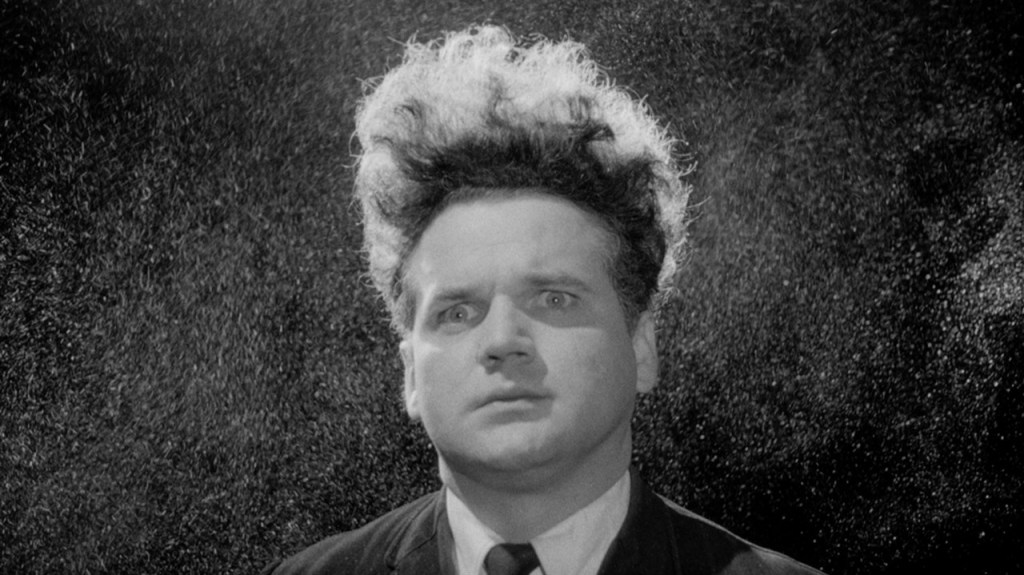
Welcome to my new series, ‘Lynch’s Legacy’, on the late great David Lynch and his filmography. I will be tackling all his feature length films progressively to truly explore his influence on cinema. This is my first series and I probably won’t always watch every film by the director I profile, especially considering how long certain directors’ filmographies are. However, with Lynch’s recent passing, I think I owe it to myself to explore all he had to offer.
Eraserhead follows Henry Spencer who has just unexpectedly had a child with his wife Mary. Only this ‘child’ is some sort of mutant that refuses to be cared for or helped and just lies there screaming. This was Lynch’s first feature length film after delivering several short films from 1967 onwards. It was filmed on a tiny budget of $100,000 and it was not exactly universally praised. To say that this is a strange and disturbing film would be an understatement of the highest order, but you would also be reiterating the general attitude towards this film for now almost 50 years. When this came out, it garnered cult following and it still holds that status today. Many dismiss this as ‘too pretentious’ or just ‘completely nonsensical’ but to do that is to miss what the film is trying to say.
To understand this film is to understand Lynch himself at the time. Obviously, him being clearly a very strange man, this is easier said than done. But this film could not have been made by somebody just guessing at the anxiety and fear of parenthood. Lynch had his first child in 1968 and he did not have another child until 1982, and that was with his second wife too. There is obviously nothing concrete to be gained from this observation but it does show a reluctance to having another child in his earlier life and career for fear of commitment. These sentiments are at the centre of Eraserhead and the ways Lynch spends this film dissecting this fear is what makes it strange and disturbing but also genius in many respects.
The biggest and most obvious way it does this is making the child unpleasant. Its alien-like appearance is perfect and it works best if you take it at face value. If you were given responsibility of a weird alien organism that seemed to reject any approach to caring for it then you too would probably not know what to do with. That is what Lynch is saying about being an actual father. Being given the responsibility of a child is no small task and it makes sense to be scared and be clueless as for what to do. It does not justify Henry’s actions outside of looking after the child but it is clearly Lynch’s reflection of his own needs to escape the heat of the situation and distract himself.
It is difficult to dissect this film because of its more surrealist elements and that applies to its technical aspects. Regarding performances and dialogue, they aren’t great. Frankly, this could easily be on purpose, purely because of the aesthetic it works with. Lynch has made it very clear that he takes a lot of inspiration from dreams to make his films. Dreams do not often make much sense at all and there is always the lingering feeling present that something is off. Eraserhead has that exact feeling. It is no secret this film does not make sense if you watch it from a surface level point of view, much like a dream would not. Furthermore, considering its disturbing elements and themes of fear, it could be argued this film is exploring a nightmare rather than a regular dream.
A challenging and an understandably polarising film, Eraserhead really set the precedent for what Lynch’s ongoing filmography would be like. Whilst this is potentially his least accessible work that I’ve watched, it is still clearly made with purpose. To call it coherent in its presentation would be a lie, even the biggest fans of it would have to agree. But considering the context, this is a film Lynch made for himself and not for anyone else which has to be admired.




 Screen Addict
Leave a reply to artisanperfectly00363a228c Cancel reply