
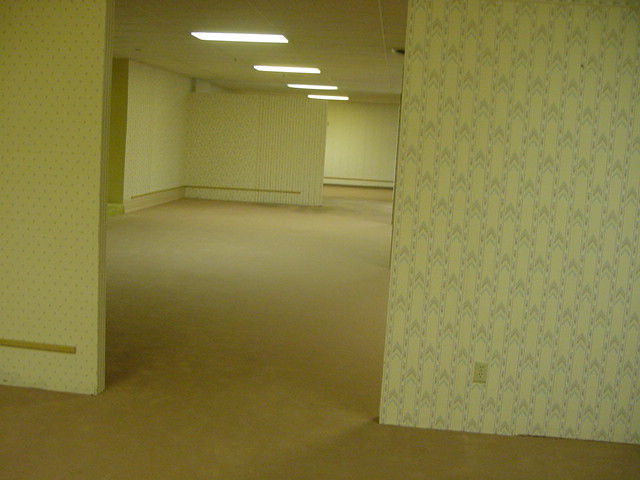
When I go to work early mornings at my job, I often come into contact with the concept of liminal spaces. Specifically on Sunday mornings, I start work at seven o’clock when most of the world is having a much-needed lie-in. As I work at a shopping centre, I am used to that place being incredibly busy, with large crowds going about their day and a sea of noise to accompany it. On those Sunday mornings, those spaces that are so often bustling with the general public are empty, and there is something eerie about that which is hard to put my finger on. Liminal spaces describe this phenomenon, places of transition that are uncharacteristically empty and thus feel strange and unwelcome. It is often related to the Uncanny Valley phenomenon, triggering a fear or discomfort response purely because something does not feel quite how it should. It is all a very interesting concept, and lots of internet horror capitalises on it. The Backrooms is one such internet-born horror idea, referring to an extradimensional space that is empty and detached from reality. Spawning from an ominous 4chan post in 2019, many horror series, games, and stories have come out of this concept.
Backrooms is the first mainstream feature film to touch on this corner of internet horror, and that is in large part due to the young Kane Parsons, the director of this film, but also a YouTube creator who has made lots of Backrooms-related content. His 24-episode web series has built a lore for its world, so if anyone were to make this film, it had to be him. Not only does Parsons manage to translate his largely cryptic series into an accessible film to those clueless to the concept, but he also showcases great filmmaking talent, particularly in some of its fully-fledged horror sequences. Though some of its story and subtext struggle to bear fruit towards its conclusion, Backrooms is a surreal and uncomfortable experience, and I mean that in the most complimentary way.
Backrooms follows Clark (Chiwetel Ejiofor), an owner of a furniture store who is struggling with his recent divorce and alcohol problem. He has no real life outside of his job, and the only person he really speaks to is his shrink, Mary (Renate Reinsve). Mary has problems of her own, struggling with memories of her mentally ill mother and the trauma of her demolished family home, and thus feeling lost and without a place. Kicked out of his home, Clark is similarly lost and essentially lives at the furniture store. One night, he notices problems with the lights in the store, and a switch on the breaker that did not seem to power anything suddenly seems connected to something through the wall of the store. Seeing a shining light through a gap in the wall, Clark finds that there is, in fact, no wall there at all, seemingly phasing into a whole other building through a portal-like opening. Exploring this new space, the ‘building’ seems to go on forever, but without purpose or any true sense of place. Furniture is phased within the walls, stairs do not go anywhere, and doors open to impossibly tight hallways; the whole place seems like a labyrinth built without any sense. Clark is enamoured by the place, going in every night and mapping the place out. However, he quickly finds that he is not alone there. With security cameras set up in places, strange radio chatter is being heard from some of its halls; they are clearly there to observe the place for whatever reason. When Clark does not show up to appointments, Mary feels compelled to make sure he is alright, and ends up stumbling upon the very same place. The two both navigate the place’s endless halls, learning that this is no building at all and is the hunting grounds for an entity that neither of them can comprehend.
Backrooms‘ writing is a tad disjointed, but when it hits its stride, it definitely makes both the concept of the Backrooms and the characters more interesting. Although written by Will Soodik, I think it is clear that Kane Parsons had a hand in a few elements, considering he seems to be the loremaster of this whole concept. What I appreciate most about the writing is its success in keeping the Backrooms’ mystery alive throughout and leaving the audience with many more questions than answers. It never overexplains itself and prefers to give the audience their own agency in figuring out what is going on. There is one phrase that a few characters use to describe what the Backrooms are: like being asked to draw a dog, having never seen a dog, and only having it described to you. It perfectly summarises the bizarre, uncanny vibe that the Backrooms gives off. It has the pieces, but cannot work out a way to put them together in a cohesive way, instead resulting in a provocative and eerie distortion of elements that we know in our world. The film never really goes beyond that explanation, and that restraint has to be admired. However, it overexplains this very explanation too many times, to the point that it does become eye-rolling. There is one scene that bridges the second and third acts, and it just feels like an unnecessary reminder of everything the film has already explained to us. It drones on for way too long, and although it does allow for some interesting character moments, it goes on to overexplain them too. Clark’s character is clearly quite lost and without any sense of belonging. So, especially as a wannabe architect, it is only natural that he is drawn to the Backrooms because instead of finding a place to call his own, he has essentially found the place of all places and becomes obsessed with it. Backrooms loves to explain this to you very explicitly, and it can be rather unsubtle in doing so. It is clever how it manages to keep its mystery alive and offers a lot of room for audience interpretation. But then it goes back on that ethos where character work is concerned, and it leaves the writing feeling a bit hit or miss.
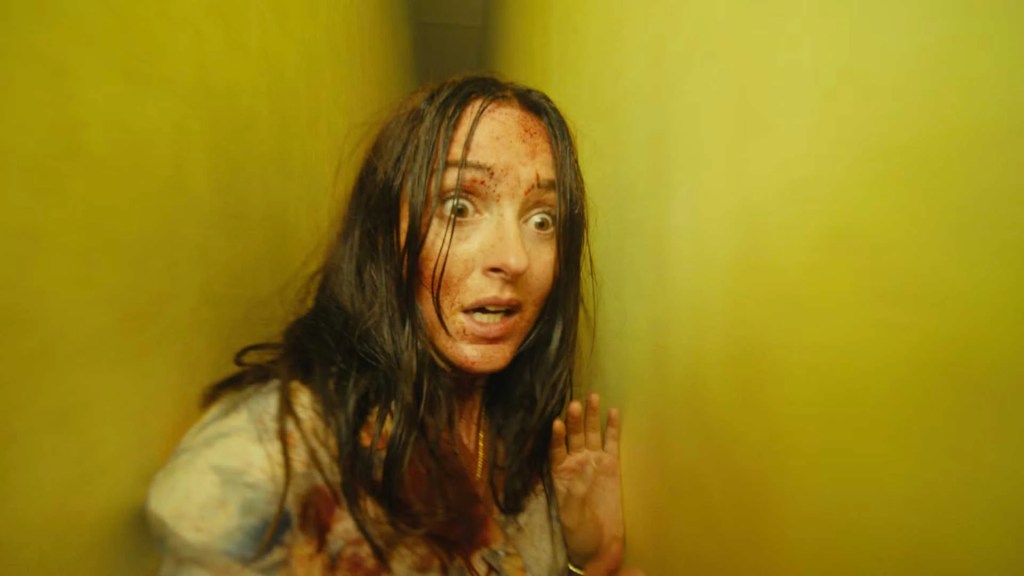
Where Backrooms really shines is in its incredible production design and heart-racing horror sequences. 30,000 square feet of sets were built for this, and it was so large and labyrinthine that people would get lost on the set. Renate Reinsve has also said that she would not go on the set alone for fear of getting lost, and also just because it does have such an eerie vibe. It is bizarre how something as simple as a bunch of yellow walls can give off such a feeling, but it does every single time. When Clark first goes in, there is never any sense of whimsy about his having found this place. It is purely that sense of dread setting in immediately, and that only grows as he delves further in, seeing its twisted distortion of reality. Of course, as Backroom fans will know, it does not just stop at the yellow walls. There is one found footage sequence around the film’s midpoint that feels like a full descent into hell. Clark is running from something not very welcoming, and we see him running through other areas of the Backrooms, all with their own distorted inflections of real-world things. One example is a particularly striking pool room with a statue-like face coming out of the wall, and the floor is all wet because it has clearly not been designed very intricately. There are a fair few of these areas that he goes through, and they are all terrifying for the split seconds that you see them. The fact that these full sets have been made only to be shown for a few seconds shows how above and beyond the production team has gone for this film. That found footage sequence that I mentioned is certainly one of the highlights of the whole film, both because of this production and how well the horror is delivered. The sounds of the entity that is following Clark screech throughout the halls, and the ominous imagery around him gives this otherworldly feel, and also the idea of him having no idea where he is going, falling deeper and deeper into the madness of the Backrooms’ liminal halls. Liminal comes from the Latin word limen, translating as ‘threshold’, so the use of these liminal spaces altogether gives that feeling of being far beyond the threshold of reality and being trapped in an extradimensional hellscape. There is something special about found footage sequences and their claustrophobic sense, a good reason why the likes of The Blair Witch Project or As Above So Below are so effective. But those films, along with this one, manage to evoke that feeling of crossing a threshold and being trapped in a place with no way out, and that first-person perspective that comes with found footage makes that fear so much more intimate.
Backrooms is a very solid horror film in a year that has already been so great for the genre. The uniqueness in the way it puts across its horror is its real highlight, preferring to build suspense and mystery and give the audience more questions at the end than they have answers. Its sets are exceptional, and they are instrumental in creating the strange, otherworldly vibe that haunts the entire film. Ejiofor and Reinsve are fantastic in their roles, showing their range very well, and the fact that Kane Parsons managed to get them in his film is amazing. How bizarre that a 20-year-old who did a YouTube creepypasta web series has made a film under A24 and has managed to get two Oscar nominees starring in it. This is the kind of success story that inspires young filmmakers, and I imagine many will try to replicate this magic in years to come. Parsons’ talent is clear, and I will be very curious to see what he does next. Even if the writing to support the film drags it down a bit, the horror craft is very strong, and it is definitely worth experiencing in a cinema.




Leave a Reply