
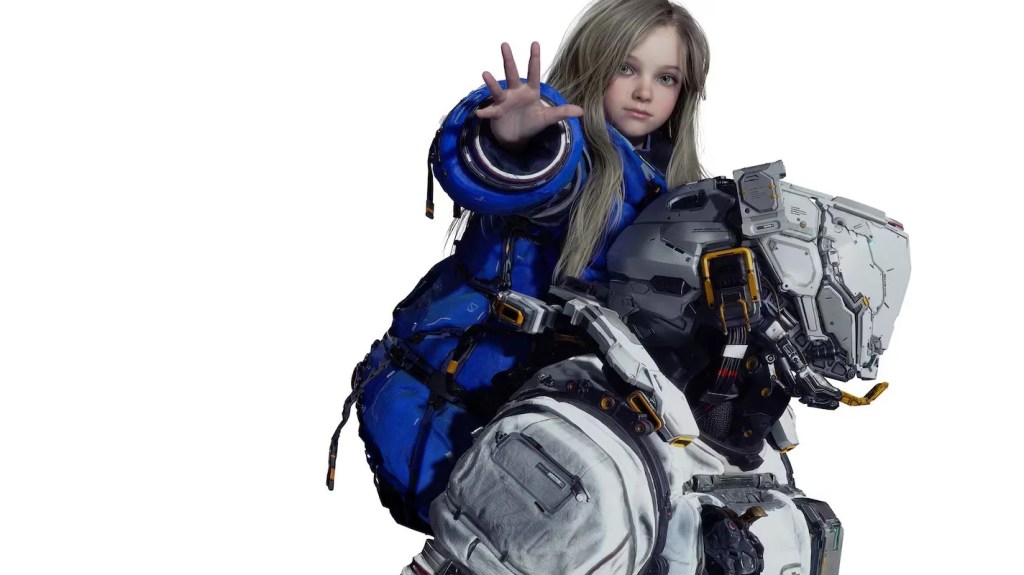
Capcom, as a games publisher, has been on a roll recently with some of the best games of the past few years being from some of its home franchises. With their remarkable heavy-hitter IPs such as Resident Evil, Street Fighter, and Monster Hunter, they have recently been churning out titles, but never skimping on quality; quite the opposite, in fact. Just in February, they released Resident Evil Requiem, which is my personal game of the year so far, and it is a game that oozes confidence and game-developing prowess that Capcom has honed for many years. Similarly, Monster Hunter Wilds, even though not one of the heights of the franchise, has found a huge player base and begs to have countless hours sunk into it. They have it all, smashing this current, and hopefully dying, live-service trend, but also managing to create brilliant narrative single-player experiences that show the absolute best of their ability. However, arguably, none of this confidence has been shown as much as in their recent release, Pragmata, a new, fresh IP that they took a chance on. With so many sequels and remakes in the triple-A gaming space, new IPs are always refreshing, but so many are scared to do so due to potential lack of sales. Well, over 1 million sales later, Pragmata has proven to be a successful chance taken, and it certainly helps that the game is great enough to reinforce that success. With lovable new characters in Diana and Hugh, to a refreshing and unique genre-blend in its combat, Pragmata proves that new IPs are worth taking a chance on, and Capcom has another hit on their hands.
Pragmata puts you in the shoes of Hugh, an engineer who is sent with his team to the moon, as there has been a communications disturbance between Earth and the moon base named the Cradle. At this facility, they mine for lunar filament, a material that has been revolutionised by the Delphi corporation into being able to 3D print virtually anything. Ran by an AI known as IDUS, the facility has numerous automatons in order to streamline development, and there are very few humans ever at the facility as a result. Whilst Hugh and his team are investigating, a huge moonquake hits, and the facility starts to crumble. Due to the endless creation possibilities because of the lunar filament, the quality of building material is low, and thus the facility is broken all over. During the accident, Hugh’s team is killed, and he is left all alone, stranded on the lunar base. However, an unlikely ally comes to his rescue, a special class of automaton in the form of a little girl. This special class is known as a Pragmata, due to their advanced nature, and Hugh nicknames her Diana. Though not a big lover of kids, Hugh recognises that he will need all the help that he can get to get out of the facility, especially considering all the other automatons have turned hostile. Using the many weapons at your disposal and Diana’s hacking abilities, you must fight through the facility, trying to stop the now hostile IDUS and find a way off the moon.
A lot happens very quickly to get the story moving in Pragmata, but afterwards, it definitely takes a backseat. The main plot is as simple as I have explained in the synopsis, and it generally does not amount to much more than that. Rather than being a plot-driven narrative full of thrilling twists and turns, Pragmata certainly opts for a more character-driven approach, developing Hugh and Diana both individually and as a duo. Possibly the most refreshing aspect of their dynamic is the levity, and how there is never any wallowing in sadness. There have been so many adult and child character-focused stories in recent times, and games like The Last of Us or God of War (2018) have been dubbed ‘sad dad’ games by the internet. Characters like Joel and Kratos in their respective games are mostly humourless, and their troubled pasts make the narratives much more sombre. Of course, that definitely fits the stories those games tell, but it is nice in Pragmata to have a character dynamic that is so optimistic and playful.
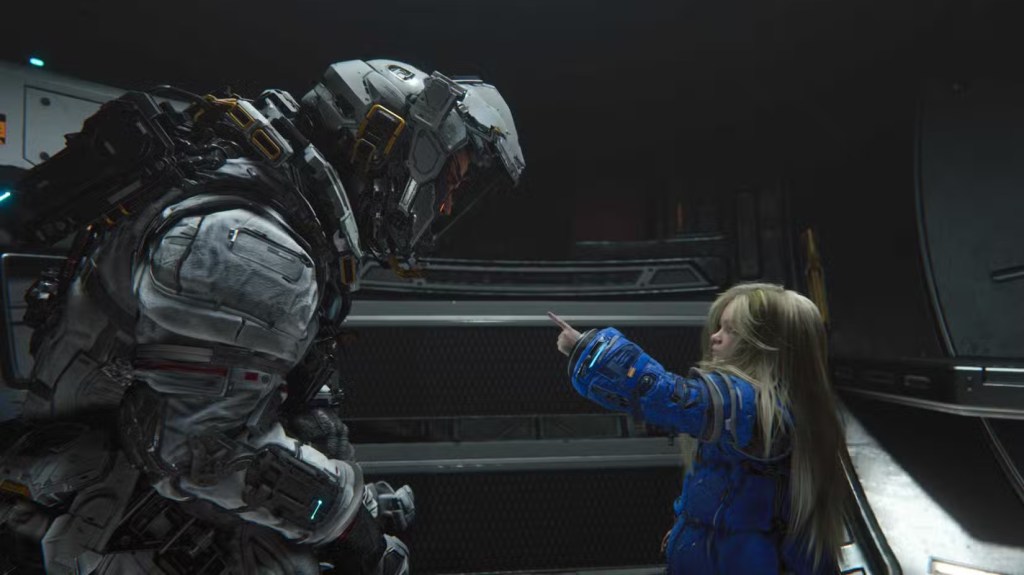
Diana is so unbelievably sweet, and the quick bond she forges with Hugh is very precious. Much like a child, she is constantly asking questions about Earth, and rather than shutting her down, Hugh is incredibly sincere and happy to tell her about his life and travels. They have good banter with each other, but also just some really lovely moments together. The scene where Hugh gives Diana her name is a lovely way to introduce that dynamic, and it is so effective at sealing their friendship going forward in a heartfelt way. Though the actual plot itself is nothing to write home about, the way they respond to what is happening, and some of the revelations towards the end, is what carries the narrative. You care about them and therefore care about their mission and what happens to them, rather than caring about any of the relatively safe plot on its own. If a sequel were to be made out of this, I would play that just to see where their stories go, and that is a testament to how well written and likeable they are.
The defining feature of Pragmata is, without a doubt, its gameplay, being constantly fun in every aspect, mostly due to the uniqueness of its combat. It blends third-person shooting with a hacking minigame that is used to make enemies vulnerable. Action buttons on the right side of a controller are used to navigate a maze-like grid, avoiding red tiles and passing through blue ones, all with the goal of getting to the green one to perform the hack. Blue tiles stack damage, and with equippable yellow nodes, you can do some incredible stuff with the hacking. Some nodes cause the automatons to overheat, meaning they can be staggered for a critical attack; some pass the vulnerability state to other enemies.
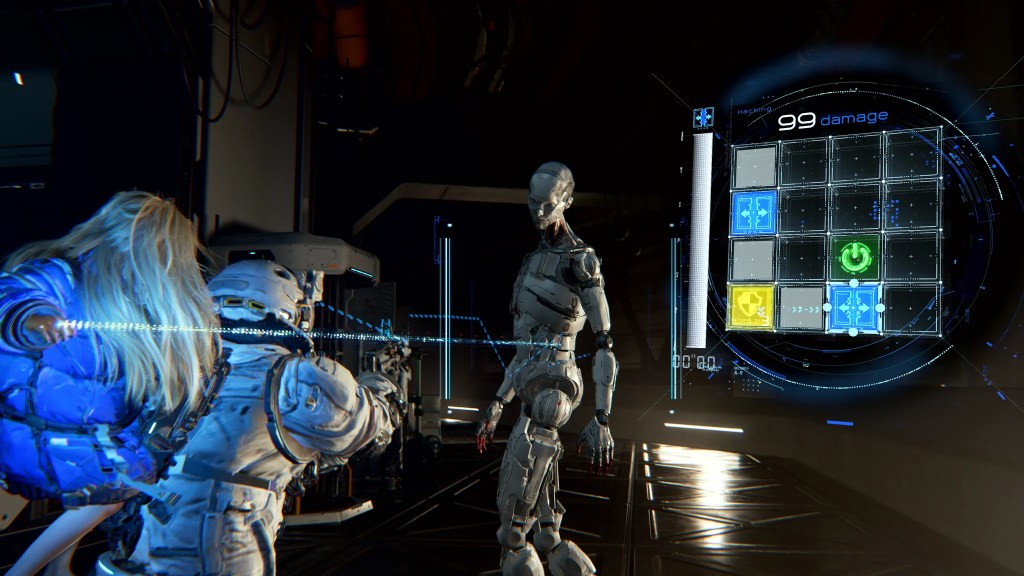
There are some brilliant possibilities, and it is addictive to see what can cause the most damage. At the same time, you will be shooting enemies with all the firepower you can find, upgrading weapons, and creating a loadout that makes your weapons and hacking perfectly synergised. For example, I loved using the freeze hacking node to keep enemies in place, making it much easier to target a weak point with the sniper-like charge rifle. There can be some pretty challenging encounters, particularly if you explore, so it never hurts to be equipped. Levels are well designed with a fair amount of variety in enemy types and different biomes in which to fight them. The best part about the levels is the exploration, though, with lots of hidden collectables that are nicely listed, ready for you to tick them off. These collectables range from currency to upgrade weapons, presents for Diana, and coins for a bingo card back at your base, which give you access to nice bonuses, such as new outfits. Completionists will definitely be happy, because there is a fair amount to collect, but also bonuses at the end of the game for areas that you have 100% of the stuff in. Whilst the collectathon is rather simplistic and very video-gamey, it works well, and you feel rewarded enough for bothering to explore.
Pragmata is a great game and yet another release that proves Capcom knows exactly what they’re doing when picking up IPs or just making games in general. With this and Resident Evil Requiem only a couple of months apart, they are having a fantastic year so far, and with Onimusha: Way of the Sword and potentially another Monster Hunter Wilds expansion coming, it may only get better for them. This game may not be stacking up as a game of the year contender, but it is certainly a lot of fun, and Hugh and Diana are such wonderful protagonists to add to Capcom’s already iconic catalogue. Even if the story is basic, they shine so brightly, and it is hard not to love the game just because of them. Still, it is definitely the combat here that is the most interesting thing going on. Your constant multitasking is riveting, and they have really made something special in that regard. All these great elements outweigh the more basic ones, and it makes for a great experience that I believe anyone can enjoy.



Leave a Reply