After replaying both A Way Out and It Takes Two recently, Hazelight cemented itself for me as a studio where I will play everything they release. I mentioned in my It Takes Two retrospective about the passion that these developers have and how much their Game Director, Josef Fares, advocates passion as the driving force behind their games’ successes. Fares has always understood what makes a game work and more importantly what makes it an absolute blast to play. For this reason, Split Fiction was the one to watch out for when it was announced a few months ago. It is Hazelight Studios’ most recent venture after It Takes Two and after how good that was, Split Fiction had a lot of high expectations to live up to. There would be no greater understatement to say that this simply met expectations because instead, it smashed through them. This is one of the most remarkable games you will likely play all year.
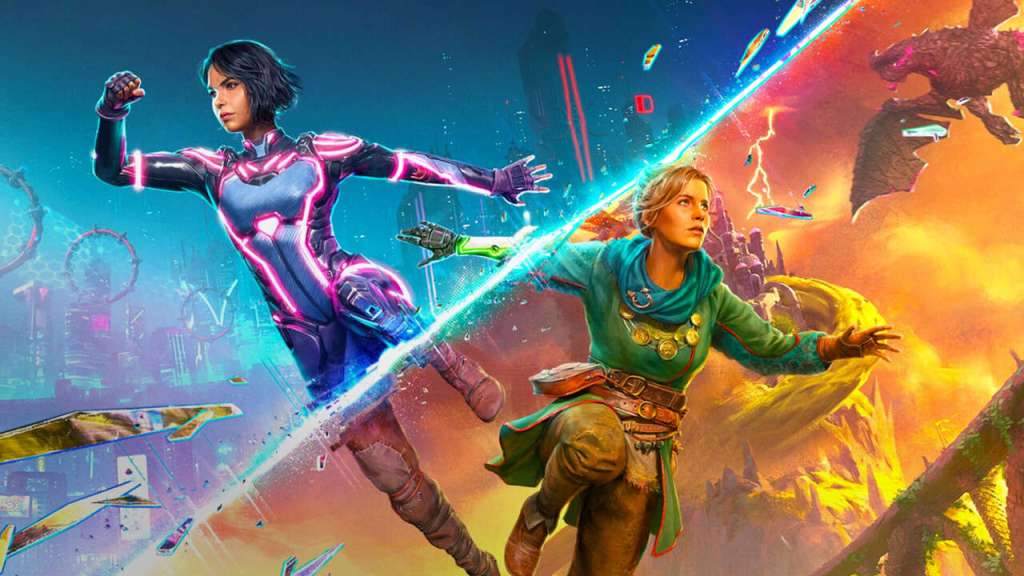
Split Fiction centres around Mio and Zoe, keeping up Hazelight’s trademark co-op only focus with two protagonists. Mio and Zoe are writers invited by Rader Publishing to test out a new machine that creates simulations based on the writers’ ideas. The pair, amongst other writers, are to be put in bubbles where they will enter their simulation. As the process begins, Mio gets cold feet and wants to leave leading to a tussle with the director of the operation, Rader himself. She topples into the same bubble as Zoe and are thus put within the same simulation. Mio’s sci-fi interests and Zoe’s fantasy interests collide within the simulation creating glitches that harm the machine. After managing to listen in to Rader, it is immediately apparent he is simply using the machine to harvest the writers’ ideas. Mio and Zoe have to traverse their stories, finding the glitches across the way in order to destroy the machine and take Rader down.
The premise of this is obviously very video-gamey but it does work well. It is horrendously unsubtle in its allusions to AI stealing artists and ideas but that is still a worthy topic of discussion. Having Rader as this remorseless businessman who cares more about the machine than the safety of others is over the top, but many CEOs in his position unfortunately do just look after themselves. The writing of this game has been criticised in relation to the full package’s quality and whilst this is slightly true, Mio and Zoe’s dynamic recovers it from being just servicable to solid. Their developing friendship throughout the game is not rushed and feels genuine. This is especially impactful in the much more deeper character moments, particularly later levels when players have to fight through the pairs’ subconscious worlds. It works really well, but follows suit with It Takes Two in the sense that the story is not the game’s main attraction. After all, this is a video game so it is a good job this gameplay is as good as it is.
Much like its predecessor, Split Fiction‘s gameplay mechanics change every level. Although this time, it is done on an even more dramatic scale. One minute, you will be equipped with a gravity shifting katana and an energy whip in a cyberpunk hellscape, and the next you will be shapeshifters in an enchanted forest. When looking at stuff like this, it is clear this premise was made just so they coud get as wacky as possible. However, when each level is as fresh and entertaining as the last, why would you want it any other way? It is just ludicrous how many creative ideas are on show for puzzles, boss encounters, or even just plain traversal challenges. Within the standard levels, there are also little side stories which are small bleeds from the others character’s ideas. For example, when in Mio’s cyberpunk city level, there is a side story glitch of Zoe’s you can access wherein you are magical pigs that collect apples. Insanity is an understatement to describe this but even in these small stories, there are fresh gameplay mechanics you will only use for a few minutes during the side story, never to be used again. Naturally, there are some levels and side stories that are weaker than others but the wealth of creativity on display is magnificent.
All of this is incredibly fun and creative but the technical prowess here is magical. There was no bugs at all during my playthrough and it ran incredibly smooth the whole time. This would be quite impressive on its own but the fact this was the case during the final sequence is baffling. The final sequence of this game is one of those rare moments where you have to question how on earth they managed to do it? It is so hard to talk about without spoiling but the whole thing is just wizardy beyond belief. No doubt once the veil of novelty is lifted and everybody has played it, people will be talking about this particular sequence for a long time. It is simply that good and that would probably even be a point of recommendation itself, even if the rest of it was not great.
It certainly does help that with this incredible final sequence and everything prior to it, both story and gameplay-wise, this is a ridiculously good game. Once again, Hazelight have created an excellent game and they also prove themselves to be one of the most consumer friendly developers out there too. Offering a game this polished at only £40, with the additional luxury of being able to get a friend to play it with you on any other platform for no extra cost, is unheard of in today’s market. This is a fantastic game and I very strongly recommend you to find somebody to play this masterpiece with.


Leave a Reply